Table of contents Toc Icon
Table of contents Toc Icon
In today’s fast-changing financial environment, accountants and CPAs are constantly seeking ways to improve efficiency, enhance client relationships, and stay ahead of regulatory changes.
According to the Thomson Reuters Institute’s 2026 AI in Professional Services Report, 34% of tax firms already use generative AI. Another 23% are planning or considering its adoption.
Based on these numbers, many accounting professionals can use ChatGPT to manage day-to-day accounting tasks, including financial analysis, generating solutions to problems, collecting information, and improving productivity.
ChatGPT prompts are shortcuts that resolve the queries of CPAs and accountants instantly, boosting their productivity and refining their practice.
Before exploring ChatGPT prompts, let’s understand the best ways to use ChatGPT accurately to get the most effective result-
- Define Objectives: Clearly define what you want ChatGPT to help with, whether it’s research, writing assistance, or problem-solving.
- Ask Specific Questions: Provide detailed, specific questions or prompts to guide ChatGPT’s responses effectively.
- Evaluate Responses: Review and assess the accuracy and relevance of ChatGPT’s answers.
- Iterate and Refine: If necessary, redefine your queries based on initial responses to deepen understanding or explore related topics.
- Use Outputs Wisely: Incorporate ChatGPT’s outputs into your work, ensuring they align with your goals and standards.
What Not to Share with ChatGPT: AI Best Practices for Accountants
Do not enter Social Security numbers, bank account details, tax returns, login credentials, or confidential client records into public or unauthorized AI tools.
Use only firm-approved tools and workspaces. Accountants should also follow their firm’s Written Information Security Plan, data-retention policies, engagement terms, and client-confidentiality requirements.
Tax professionals remain responsible for due diligence, accuracy, confidentiality, and the review of AI-generated content. The IRS also requires tax professionals to maintain a Written Information Security Plan to protect taxpayer data.
Even when an approved AI tool is used, a qualified professional should verify tax positions, calculations, financial conclusions, and regulatory guidance.
ChatGPT Prompts for Creating Invoices, Reports, and Notes
Creating invoices, reports, and notes is a fundamental part of an accountant’s or CPA’s work. ChatGPT can help prepare initial drafts, organize information, and save time. However, users must verify the accuracy of all figures and client details.
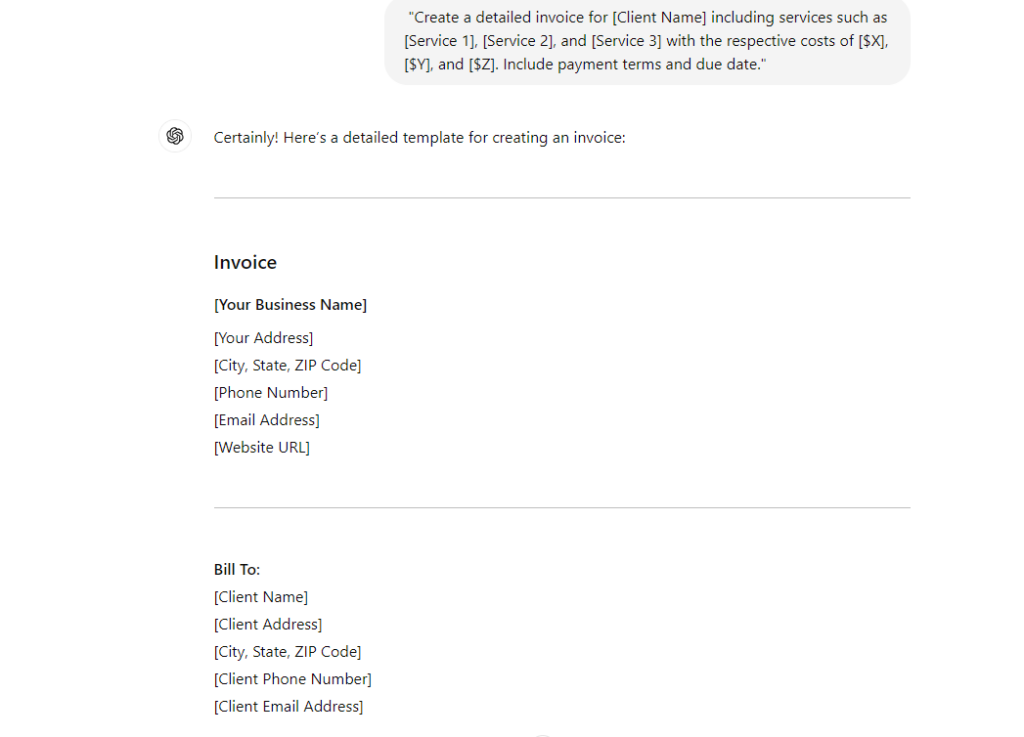
1) “Create a detailed invoice for [Client Name] including services such as [Service 1], [Service 2], and [Service 3] with the respective costs of [$X], [$Y], and [$Z]. Include payment terms and due date.”
2) “Using only the financial information provided below, generate a financial report for [Client Name] for the quarter ending [Date]. Include income, expenses, profit and loss, cash flow observations, and a summary of financial performance. Identify any missing information and do not create figures that are not in the source data.”
3) “Using the accounts receivable data provided below, create an accounts receivable report for [Client Name] as of [Date]. Include outstanding invoices, aging categories, balances, due dates, and recommended follow-up actions. Do not change or estimate any figures.”
4) “Prepare notes summarizing the tax preparation process for [Client Name] for tax year [Year] in [Jurisdiction]. Include required documents, relevant deadlines, open questions, and areas requiring professional review. Use only the information and official sources provided.”
5) “Using the approved financial records provided below, generate a year-end financial summary for [Client Name] for [Year]. Include annual income, expenses, major financial events, cash flow observations, and overall financial performance. Clearly identify assumptions and missing information.”
Prompts for Excel formulas for Accounting
Prompts for Excel formulas help accountants and CPAs by providing precise instructions for tasks like data lookup, error handling, loan calculations, and data summarization.
These prompts can simplify complex operations, support accurate analysis, and improve reporting efficiency. Here are some ChatGPT prompts for accounting formulas:
6) “How do I use SUMIF to add all expenses categorized as ‘Office Supplies’?”
7) “Show me how to use XLOOKUP to return a client’s assigned tax rate from an approved state-rate table. Also provide a VLOOKUP alternative for older Excel versions.”
8) “Explain how to use PMT to calculate monthly loan payments.”
9) “Show me how to use CONCAT or TEXTJOIN to combine first and last name columns while correctly handling blank cells.”
10) “Show me how to use XIRR to calculate the internal rate of return for irregular cash flows.”
Prompts for Client Communication
Client communication prompts are essential to ensure clear understanding, compliance with regulations, trust-building, managing client expectations, effective problem-solving, and maintaining proper documentation.
These prompts facilitate transparent and informed discussions, enhancing the quality of customer service.
11) “Compose an email introducing a client to a new service you are offering, highlighting its benefits and how it can help them.”
12) “Write an email reminding a client about an overdue invoice, including the invoice number, amount due, and payment instructions.”
13) “Draft an email providing a client with a year-end financial summary and an overview of their financial performance.”
14) “Compose an email confirming receipt of a payment from a client, including the amount received and the updated balance.”
15) “Compose an email requesting the necessary tax documents from a client for their upcoming tax filing.”
Prompts for Financial and Market Analysis
CPAs and accountants can use financial and market analysis prompts to enhance decision-making, identify trends, forecast financial outcomes, and provide strategic insights.
These prompts can support financial reporting, risk assessment, and performance analysis. However, ChatGPT should work from reliable source data, and a financial professional should review its findings.
16) “Using the company information provided below and current primary-source guidance for [Jurisdiction] and [Tax Year], identify potential tax-planning areas that a CPA should review for [Company Name]. Cite every source, list all assumptions, and do not present the output as final tax advice.”
17) “Analyze the market share trends of [company name] compared to its competitors and assess the implications for financial performance.”
18) “Using the attached financial statements for [Company Name], identify important changes in revenue, expenses, margins, assets, liabilities, cash flow, and financial ratios. Support each observation with figures from the statements. Identify missing information and do not invent data.”
19) “Find the latest available stock price for [Ticker] on [Exchange]. Include the currency, market status, retrieval time, and source. Do not estimate a price if current market data is unavailable.”
20) “Assess the financial risks faced by [company name] and recommend risk management strategies to mitigate these risks.”
Tax Payments Prompts
Tax research and compliance prompts can help accountants locate relevant guidance, organize tax information, prepare clients for filing, and identify issues requiring further review.
Because tax regulations can change, professionals should include the jurisdiction, tax year, client type, and relevant filing period in each prompt. They should also verify the response against current IRS, Treasury, state, and local tax authority guidance.
21) “Using current IRS sources, explain how an eligible taxpayer can request and manage an installment agreement for outstanding federal tax liabilities. Include available plan types, eligibility requirements, application methods, fees, payment responsibilities, and links to the relevant IRS pages.”
22) “What are the best practices for maintaining accurate and comprehensive tax records throughout the year?”
23) “What steps can I take to ensure my clients are well-prepared for potential tax audits?”
24) “Compare current tax preparation software options for a [Solo Practitioner, Small Firm, Midsized Firm, or Large Firm]. Evaluate supported return types, diagnostics, integrations, security, remote access, pricing structure, and customer support. Use current vendor sources and clearly state the comparison date.”
25) “Summarize tax-law changes introduced since [Date] that may affect [Client Type] in [Jurisdiction] for [Tax Year]. Use IRS, Treasury, state tax authority, or other primary sources. Include effective dates and identify any guidance that remains unresolved.”
ChatGPT Prompts for Risk Management Strategies
Risk management prompts can help accountants and CPAs identify, assess, document, and mitigate financial, operational, regulatory, and cybersecurity risks.
These prompts guide the evaluation of threats such as market volatility, fraud, compliance gaps, control weaknesses, and operational disruption. They can support the development of a structured risk management framework.
26) “What methodologies can I use to identify and assess financial risks specific to my clients’ industries?”
27) “What best practices can I recommend to my clients for preventing and detecting fraud within their organizations?”
28) “Which risk management frameworks are most effective for small to medium-sized enterprises, and how can I tailor these frameworks to fit my client’s needs?”
29) “How can I develop and implement effective internal controls to mitigate financial risks for my clients?”
30) “What strategies can ensure my clients remain compliant with evolving regulatory requirements to minimize legal and financial risks?”
Prompts for Future Trends in Accounting
Future trends in accounting are necessary for CPAs and accountants to stay ahead of industry changes and innovations.
These prompts help accounting professionals anticipate and adapt to evolving technologies and understand changing market dynamics.
With the help of these prompts, professionals can focus on emerging trends, accountants can enhance their skills, and improve strategic planning.
ChatGPT Search can retrieve timely information from the web and provide links to relevant sources. However, tax, regulatory, financial, and compliance information should always be verified against current primary sources before use.
31) “What regulatory developments have affected CPAs in [Jurisdiction] since [Date]? Use primary sources, include effective dates, and separate enacted requirements from proposals or pending guidance.”
32) “What role will automation and AI play in the future of accounting?”
33) “How can CPAs ensure cybersecurity in an increasingly digital accounting environment?”
34) “How is the role of CPAs evolving from traditional accounting to client advisory services?”
35) “How could real-time reporting, continuous accounting, predictive analytics, and AI-assisted workflows change month-end close and client advisory services over the next three years? Separate current practices from forecasts and cite recent sources.”
Cost Control Strategies Prompts for ChatGPT
Cost control strategies prompts for accountants and CPAs are vital for identifying areas to reduce expenses and improve profitability.
These prompts help in analyzing financial data, setting budgetary goals, monitoring expenditures, implementing cost-effective practices, enhancing financial efficiency, and ensuring that resources are optimally utilized, supporting the financial stability and growth of the organization.
36) “What are some proven cost control strategies that businesses can implement to improve financial performance?”
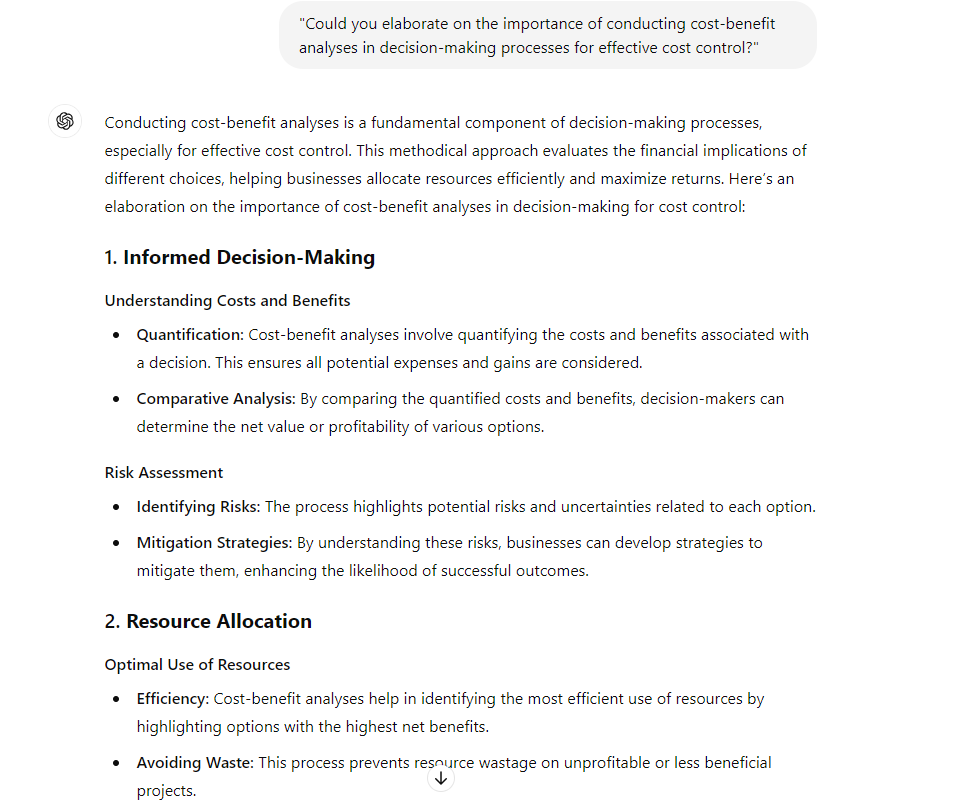
37) “Could you elaborate on the importance of conducting cost-benefit analyses in decision-making processes for effective cost control?”
38) “From a financial standpoint, how can businesses strike a balance between cost control measures and maintaining high standards of quality and customer satisfaction?”
39) “What innovative methods have you seen companies adopt to effectively manage and reduce operational expenses while maintaining profitability?”
40) “How do you recommend integrating budgeting and forecasting to effectively manage and control costs within organizations?”
Financial Modeling Prompts
Financial modeling prompts are necessary as they guide the development of detailed and accurate financial models, aiding in forecasting, valuation, and strategic planning.
They ensure comprehensive analysis by highlighting key financial metrics, scenarios, and assumptions, ultimately supporting informed decision-making and enhancing the credibility of financial projections and business strategies.
41) “What are some essential tips for building accurate and reliable financial models?”
42) “How should one approach forecasting in financial modeling to account for uncertainties and changes in market conditions?”
43) “What key components should be included in a comprehensive financial model for strategic decision-making?”
44) “What software tools or techniques do you recommend for creating effective financial models?”
45) “Build a three-scenario financial model for [Company or Project] using the assumptions provided below. Include base, upside, and downside cases covering revenue, costs, cash flow, break-even point, and key sensitivity drivers. Show the formulas and clearly label every assumption.”
Business Valuation Prompts
Business valuation prompts can help accountants and CPAs organize information, compare valuation methods, document assumptions, and prepare questions for further analysis.
They can streamline parts of the valuation process, but AI-generated content should not replace professional judgment, applicable valuation standards, or an independent review.
46) “What are the main methods used for valuing businesses, and how do they differ?”
47) “How does the asset-based approach to business valuation work, and in what situations is it most applicable?”
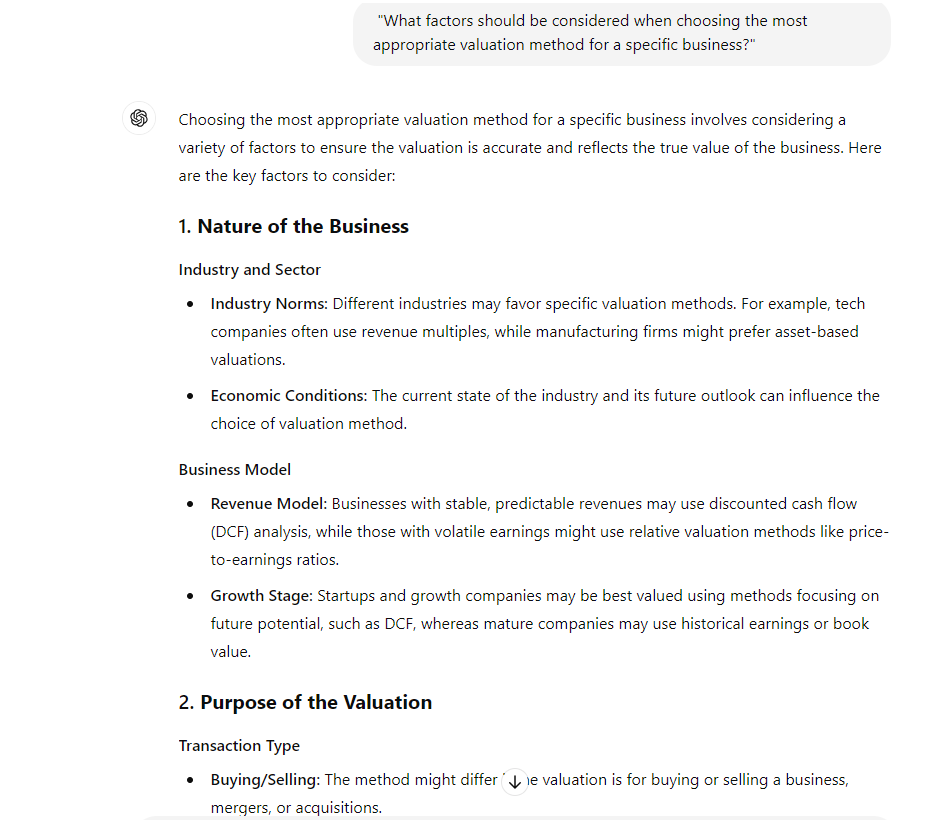
48) “What factors should be considered when choosing the most appropriate valuation method for a specific business?”
49) “What is the market approach in business valuation, and how does it compare to other methods?”
50) “What are some common challenges or considerations that arise during the business valuation process?”
These 50 prompts are just the beginning of how you can leverage AI to optimize workflows, improve client interactions, and stay ahead in the rapidly evolving financial landscape.
As technology continues to advance, embracing tools like ChatGPT will be crucial for CPAs and accountants aiming to provide exceptional service and maintain a competitive edge.
More ChatGPT Prompts for CPA and Accounting Workflows
Beyond drafting, research, and financial analysis, ChatGPT can support structured accounting workflows. These include general ledger reviews, month-end close planning, audit preparation, advisory meetings, and internal AI governance.
The following prompts provide clear instructions, define the required output, and help prevent unsupported conclusions. Firms should use approved data sources and review every result before taking action.
General Ledger Review Prompt
51) “Review the attached general ledger for [Period]. Identify duplicate entries, unusual round-dollar amounts, weekend postings, unexpected account combinations, and material changes from the previous period. Present the results in a table with the entry, reason it was flagged, supporting data, and recommended follow-up. Describe each item as a review item, not evidence of fraud.”
Month-End Close Prompt
52) “Create a role-based month-end close checklist for a [Business Type] using [Accounting Software]. The close must be completed within [Number] business days by a team of [Team Size]. Include each task, owner, dependency, due day, required source data, review evidence, and likely bottlenecks.”
Audit PBC Checklist Prompt
53) “Create a Prepared by Client checklist for a [Type of Audit or Review] covering the period ending [Date]. Use the engagement scope provided below. Organize requests by financial statement area and include the document requested, purpose, responsible person, due date, and review status. Do not add requirements outside the stated engagement scope.”
Client Advisory Meeting Prompt
54) “Using the attached profit and loss statement, balance sheet, cash flow statement, budget, and previous meeting notes, prepare a client advisory meeting brief. Highlight key trends, financial drivers, risks, opportunities, questions to ask, and three practical next actions. Support every observation with the provided data and label any missing information.”
Accounting Firm AI Governance Prompt
55) “Draft a one-page internal checklist for responsible generative AI use in an accounting firm. Cover approved use cases, prohibited client data, approved tools, human review, source verification, record retention, client disclosure, incident escalation, and employee training. Align the checklist with the firm’s WISP and clearly mark items requiring legal, compliance, or professional-ethics review.”
Using ChatGPT Responsibly in Accounting
These 55 ChatGPT prompts for CPAs and accountants are starting points for improving routine workflows, organizing information, preparing drafts, and supporting client communication. Their effectiveness depends on the context, instructions, and source data provided.
ChatGPT responses should be treated as working material rather than final professional conclusions. Tax positions, financial calculations, compliance interpretations, valuation assumptions, and client recommendations require review by a qualified professional.
Accountants should also protect taxpayer information by using firm-approved tools, following internal security policies, and avoiding the disclosure of confidential data in unauthorized AI systems.
When combined with reliable data, appropriate security controls, and professional judgment, ChatGPT can help accountants spend less time on repetitive work and more time supporting clients and making informed decisions.