Table of contents Toc Icon
Table of contents Toc Icon
Accounting firms have relied on hourly billing for decades, but many firms now question whether billing by time truly reflects the value of their expertise. As firms expand advisory services and clients expect more strategic guidance, firms must rethink how they price and position their services.
Value pricing does more than change the billing model. Value pricing helps firms focus on outcomes, communicate their expertise more effectively, and build stronger client relationships. However, many accounting professionals still struggle to move away from hourly billing because the transition feels unfamiliar and difficult to structure.
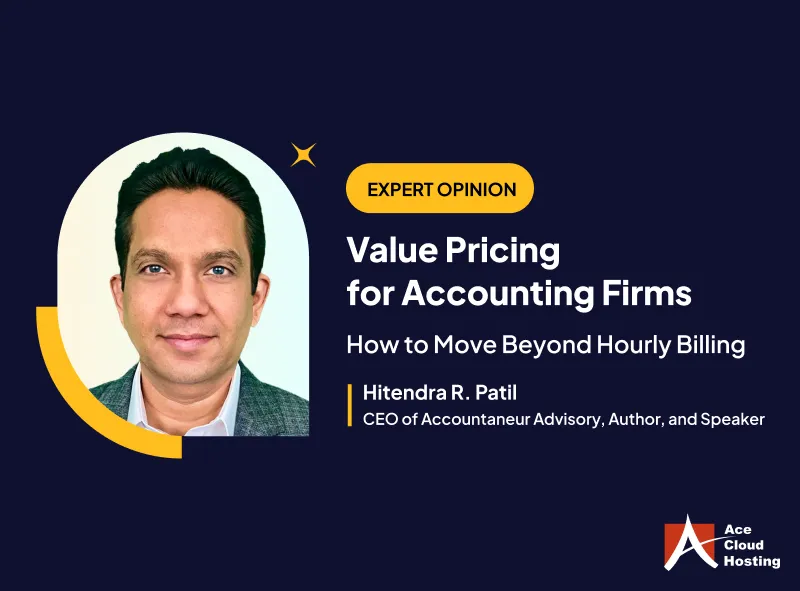
In this conversation hosted by Ace Cloud Hosting, Seth Fineberg, Founder of Accountants Forward, sits down with Hitendra R. Patil, Founder of Accountaneur® Advisory, to discuss how accounting firms can move beyond hourly billing and adopt a more value-driven pricing approach.
Transcript
Seth: Hi again, I’m Seth Fineberg on behalf of Ace Cloud Hosting. I am very honored and happy to see my friend and longtime colleague, Hitendra R. Patil, sitting right across from me. Our topic today is not a new one.
We are going to be discussing the issue of value pricing and, really, the larger issue of pricing your services the right way. We’re in the second quarter of the 21st century right now, and it’s time that if you haven’t really kind of gone on that journey or maybe you’ve started doing some fixed fee things, what have you, maybe you just haven’t quite figured out how to do it. Well, Hitendra has actually written a book on the topic, and I feel that he’s a pretty good authority on the things to do and not to do. Hitendra, welcome.
Hitendra: Thanks for having me, Seth, and thank you for the kind introduction. And as you know, I spent years in professional services intersections, and I’ve been watching really talented, great accountants, I would say, dramatically undercharged for their work.
I don’t want to sound sensational, but I sometimes feel that very deep inside me that bothered me, that continues to bother me. They’re excellent at their work. The pricing model just keeps working against them.
So, today, hopefully, we can dive a little deeper into how firms can start charging in a way that actually reflects what they’re worth.
Seth: Exactly what they’re worth. I love that. Why is building by the hour such a trap for professional firms?
Hitendra: Yeah. So, I worked with a firm that had a very intense bookkeeper who could close a set of books in like two hours flat. And I’m not talking about a completely automated kind of scenario. A really good bookkeeper in the same work.
And the same work would possibly take a junior accountant six to seven hours, maybe ten.
So, under an hourly billing model, the expert would get paid less, right? Because the same output, she was doing faster.
And if you charge for seven hours, when you work for, let’s say only two, you’re risking yourself to moral injury, you know, and accountants are ethically great people. And because otherwise your conscience eats you from inside, like I’m charging the client way too much more than I should be. So, should I be charging less because I have become more expert? That’s the problem with the model in one story.
And the model is so tightly integrated in our professional services field that most people never stop to question it. You charge for time, you track your time, you bill for time. It all feels fair. Clients are kind of used to it, but it puts a hard ceiling on your income. 40 billable hours. So, let’s say a hundred dollars an hour, 4,000 full stop. And as you get more experienced, you’re going to earn more or less, less, on projects because it takes you fewer hours.
The relationship problem is also that, you know, as bad as, because when there is no agreed total, and the client doesn’t know what the bill is going to be, because they will start second-guessing you, and they wouldn’t pick up the phone and ask a quick question just in case it shows up on my bill.
That’s exactly the antithesis of advisory services. We all want to go and upgrade to selling advisory services. And the clients are worried about asking questions because of the billable hours. It’s like confusion that doesn’t need to be there.
And in fact, some research studies indicate that between 50 to 60% of professional services firms still work this way, which means a lot of room for anyone willing to do it differently.
Seth: Indeed. So, you know, when we talk about value pricing, the emphasis is on the very first thing you mentioned, which is on value. It’s a tough thing to look at yourself in the mirror and just say, what is the value of me and what my firm does? So how do you define it? How do you kind of get on that journey?
Hitendra: Yeah, I think it’s easy for accountants to fall into the trap of assuming it means charging whatever you want and see what sticks. If something sticks, okay, let’s go with that. But it’s actually more disciplined than hourly billing.
You price based on what the work is worth to the client. And that’s difficult because it’s now somebody else is deciding your worth, not you. So how do you know how you’re getting perceived and what the worth is? So, it’s not hours.
So, which means first and foremost, you have to understand the client’s business, what they’re trying to achieve, and what your work actually means for them.
So, if you help a business owner, for example, restructure the finances and save them $80,000 in taxes over three years, what was that worth? A lot more, I think you would know, you would charge, let’s say, $100 an hour, 10 hours, it’s a lot more than that.
If you go to an attorney, what they’re doing is they’re not charging you for drafting a contract. You know, they are charging you for the expertise, the judgment, the risk that they’re taking on. And the same idea, your price connects to the client’s situation, not your timesheet. So, that is where the value pricing goes towards.
And again, value is perceived. And as you go deeper into value pricing, you will start seeing what value is getting perceived from the client’s point of view. And that’s when you become a little better. So, it always starts with a bit of experimentation, and then you kind of zero in.
Seth: Thank you. Can you walk us through what it looks like to package a service around outcomes? As you had mentioned, it’s not so much about how much time it takes you to do something that gets factored in; of course, you should be factoring in your time, right? But ultimately, it’s about outcomes. So, walk us through what it looks like to package a service around outcomes rather than tasks.
Hitendra: Okay, so one thing I want to be upfront about is that outcomes are not outputs. It’s not a report. It’s not a tax return. Okay, so let’s define that a little differently.
So, I was working with a CPA firm, not too big, not too small, a few years back, and helping them to move towards value pricing, I would say, get away from the hourly pricing. So, one of their clients was a classic case; the client ran a midsize consulting business and had asked the CPA firm to help with monthly reporting.
Now, look at the client’s language, monthly reporting, I need better reports. And the CPA partner kind of assumed that it was a bookkeeping scope question. Do you need more analytics kind of question?
So, I said, wait, let’s dig in. Why did this client come back suddenly one day and say, if you want better reporting, what’s happening? So, when we figured out, basically what the client wanted was, when the client wants to go to the board meetings, that person wants to be confident about what they’re presenting because the board would ask questions.
And it’s not just a numbers question; it’s linked to certain business decisions made or not made. Completely different engagement. Actually, the firm ended up pricing it at nearly two and a half times more than what they had originally planned based on the so-called hourly rates.
So, what I tell the firms to do before they ever talk price is have this, what we call in the SaaS world, a discovery conversation. So, find out what the client is actually trying to achieve. We need clean books. Clients are not trained to express these things clearly.
So, you’ve got to dig in. So, what is underneath what they’re saying? Is it raising investments? Is it planning to sell in a few years, or is it just exhausted, and somebody wants someone else to handle that? That answer changes what the engagement is worth.
The second question I push the firms to ask is, what would it mean for you, Miss or Mr. Client, if we solved this problem? And that’s where the real worth of the engagement comes out. And then the third question is, okay, tell me if you don’t solve it, and what will it cost you not to fix this? And sometimes that could be money. It could be late filings. It could be missed deductions. It could be, oh, I’m on the edge every day, worried about something. It could be anything.
Oftentimes, it is actually time, stress, and decisions made on gut feel without good information. And those are the firms that ask those questions, which would consistently find that the pricing conversation gets a lot easier. Most of the firms I see jump straight to the scope and the price. You actually deliver an engagement. Here is the scope: you’re picking all that stuff. It’s like predefined, right?
Many of the small business clients might need that predefined, but the clients where advisory becomes, or value pricing becomes really valuable, important, is those clients where you need to figure out. And if you skip that conversation, value pricing is not going to stick for them. They’ll come back and resent it. They’ll come back and haggle it, you know?
Seth: We’ve mentioned advisory a few times. Obviously, for most firms, they’re starting to get their head around what that is. And it starts with very pointed conversations, actually asking questions, digging into the business, to the things they’re concerned about, and going from there. And I know you are a strong advocate for a big part of beginning those conversations is also pricing upfront.
When it comes around to, okay, I’m going to deliver you X for Y price, and you explain what goes into that. So, I know you’re a strong advocate for pricing before work begins. Why is that so important?
Hitendra: Actually, this is the one I feel most strongly about. Price, not the rate, okay? Price before the work begins, always, no exceptions.
So, if you skip the upfront pricing, and you’re walking into a hard conversation at the end, that’s what will happen. And either you’re undercharged because you’re uncomfortable raising it, or you send a bill that’s higher than what the client expected, and you’ll spend the next hour defending yourself instead of being thanked or doing good work.
So, I’ve seen this go wrong many times. A firm does great work, the client is happy with the results, and the invoice arrives, $3,000, $4,000, or $2,000 more than what they expected. Suddenly, the whole conversation is about money, the hours, not the work. The relationship takes a hit. Sometimes the client leaves. All of that is avoidable.
And when you price upfront, you give the client certainty. They’ll ask questions then and there. Why this much price? What is included in the price? All of those questions will come up for not after. They’re not justifications afterward.
Then, most of the time, you’re writing off because the client is unhappy. The client knows what they’re committing to when you’re pricing upfront. They can budget for it. And when the work is done, they will pay without a second thought, really, because it’s already done. They know everything.
And looking someone in the eye and saying, “This engagement is $6,000.” Here is what you will have at the end without hedging and apologizing. That signals the confidence you have in your pricing and your work. And one of the things that I always tell CPAs is that it is not about what you do. It is tempting to say, OK, I will do this. We will reconcile everything. We’ll give you this report. We’ll do your cash flow. That’s all outputs, not outcomes.
It is not about what you do, but it is about what happens because of what you do. And the more you inform the client, explain to the client, ok, of all the things that we do, here is what’s going to happen because of that to your business, for your business, then it all starts working out.
Seth: So great. These have been wonderful insights, Hitendra. A couple more questions for you, very pointed. Someone who wants to get started on this journey, or maybe they already have, they’ll go, oh, well, I’ll do a fixed fee for certain things. ok, but we talked about having the conversation.
We talked about being upfront. We talked about outcomes. You’ve given the blueprint. Where does a firm start that maybe hasn’t gone on this journey very much yet?
Hitendra: So first and foremost, of your client mix, maybe about 15 to 20 percent of your clients would be a good fit for advisory and value pricing. Not everyone.
If you predominantly deal with mom and pop shops, small businesses, that’s not where you’re going to have this conversation. And whenever you see the fit, the bigger clients, the more transaction-heavy clients who need more information to make decisions, those are the clients where the fit is.
So, the first conversation about value pricing will be nerve-wracking. I want to be honest about that. And there are ways to make it less nerve-wracking. So, you pick just one service, something that you’ve been delivering for years. You know that inside out and can describe that clearly in terms of what the clients walk away with in your sleep. Also, you can explain that it could be anything, your annual tax planning process, your management accounts, whatever that is.
So, write down what the client has at the end of that engagement, not the task completed, the actual deliverable. It could be a tax plan. So, it might be a document, but it has an impact. What happens because of that thing?
The person has to know, ok, you gave me these 17 pages of a plan. What’s the end result that I can expect? So, it could be a clearer view of their cash positions, numbers they actually understand to make decisions. It could be anything, something that you’re really an expert in.
And then you ask yourself, what is that worth to the right client? What would it cost them to go without it? So, let’s say I have a small business, and tax planning could save me $15,000 or $150,000. And I’m like, wait, I was wasting that money all this time. Why didn’t you tell me before?
So, price it like a flat fee, a specific number, not a range. Ranges generally will invite negotiations and signal you’re not sure what it is. You then have one conversation when you present that price and see how it goes. Most people will find that clients will accept it more readily than expected as long as you explain things correctly. And especially if your discovery conversation has been done well.
And once you’re done, that gets easier. The second client is less nerve-wracking than the first. By the fifth or sixth, it’s just the way you work. You don’t need to overhaul everything on a Monday morning.
Seth: Absolutely. Hitendra, this has been very enlightening. It still surprises me how many firms are still very tied to the hourly bill, feeling that this is the way they’ve always done it. This is something they’re comfortable with. It just might not be the best business model. So, I appreciate you at least outlining how it can be different. Thank you so much for your time.
Hitendra: Thank you for having me. I hope people get even one action point from this. We have done our job.
Seth: Thank you so much.
Hitendra: Thank you.
Subscribe to Ace Cloud Hosting today to receive expert content, practical advice, and thought-leadership insights that help businesses stay competitive, secure, and future-ready.