Table of contents Toc Icon
Table of contents Toc Icon
In many accounting firms, being a high performer still means handling more work, longer hours, and constant urgency without showing signs of strain. Over time, that approach can turn strong employees into burned-out employees, especially when firms rely too heavily on billable hours and utilization to measure success.
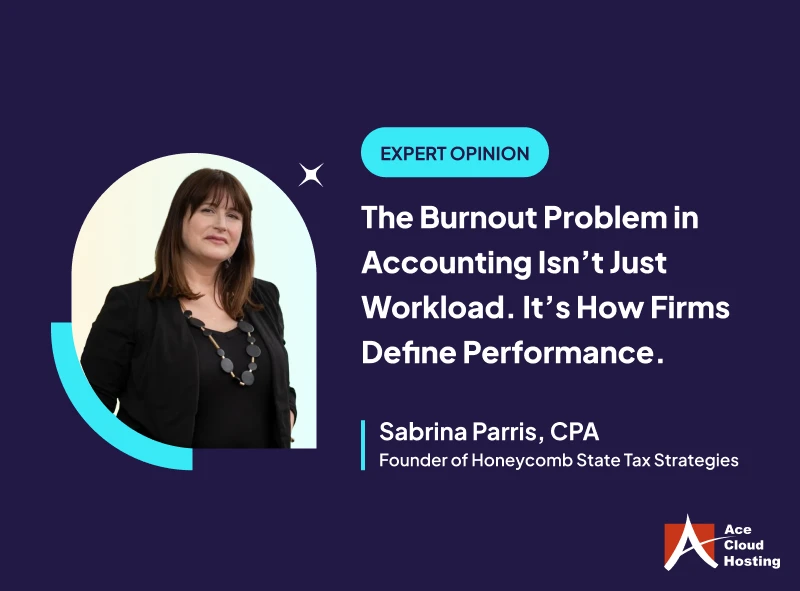
To explore how firms can build healthier, more inclusive workplaces without lowering standards, Ace Cloud Hosting spoke with Sabrina Parris, CPA.
With nearly two decades of tax and accounting experience, Sabrina is the founder of Honeycomb State Tax Strategies and co-founder of Ovata Collective, a community that supports neurodivergent accountants.
In this conversation, Sabrina explains why traditional performance metrics can reward unhealthy habits, how neurodivergent professionals contribute overlooked strengths, and what firm leaders can do to reduce burnout while maintaining accountability and client service standards.
1. Many accountants are labeled “high performers” because they push through stress and urgency. How can firms tell the difference between strong performance and unhealthy overcompensation?
Even the highest performers need breaks from constant stress and urgency. So many employers reward their top performers by giving them more work, hours, and stress. While it’s tempting to only “check in” on team members who consistently need more help, I recommend having a short one-on-one check-in with everyone individually, and it should be built into the weekly schedule. It can be as little as 5 minutes a week, but it shows your team that you care about their well-being and workplace satisfaction.
There must be two-way trust in order for this to work; otherwise, employees will tell you what they think you want to hear, so this strategy must be part of an overall healthy work culture.
2. You’ve spoken openly about ADHD and neurodiversity in accounting. What are some strengths neurodivergent professionals bring to firms that are still widely overlooked?
Neurodivergent professionals are often skilled in pattern recognition and focus under pressure, which are great skills to have in tax and accounting. They may also excel in outside-the-box thinking.
Someone who may struggle with some of the more mundane and repetitive aspects of our job may greatly benefit from a break to do something big-picture, like training new staff, documenting processes, workflow mapping, and troubleshooting outdated firm procedures.
As a manager, it isn’t important to identify potentially neurodivergent team members. Instead, when opportunities arise to work on a new project outside of the norm, rotate which staff you ask for help. You may be surprised by who excels in different types of work.
Recommended Reading: ADHD in Accounting: A Hidden Competitive Advantage for CPA and CAS Firms
3. Why do traditional accounting firm metrics like utilization and billable hours often fail to capture how people actually work best?
Strict interpretation of utilization, realization, and billable hours incentivize bad habits such as timesheet padding and underreporting or “eating time.” Staff feel constant pressure to meet their charge-hour goals while staying “under budget”, and this is a recipe for burnout. The utilization metric in particular leads to neglect of important firm-building tasks that are non-billable.
If mentoring, recruiting, training, and business development are important to the growth of your firm, why is management punishing the people who are charged with these tasks?
4. What small operational or communication changes can firms make to reduce burnout while still maintaining accountability and client service standards?
A quick and easy fix is workstyle profiles on file for each member of the team. This is a short document that highlights what time of day someone is most productive, how they best learn, and how they prefer to receive instructions and feedback.
The idea isn’t to give everyone exactly what they want at all times, but instead, create a team flow that makes sense, as well as build understanding for the way we all work.
You can find free examples online, but I recommend customizing one for your firm and including it in the onboarding process. AI is a great tool for creating custom workstyle profiles.
As someone who is self-employed, I protect my sanity by setting boundaries and enforcing them. If you are in leadership, your team needs to see you enforce boundaries for yourself and on their behalf.
If leadership says that their people are their greatest asset, it doesn’t feel authentic when clients are allowed to drop off a shoebox of receipts the day before their tax return is due.
Something that can be done at all levels is to figure out your preferred communication style, share it with your team, and ask how they prefer to communicate.
Do you send middle-of-the-night emails? Make sure your team knows you don’t expect a response outside of normal working hours, or better yet, use delayed delivery.
Do you have a time of day that you find is best for intense focus? Protect that time by blocking off your calendar or updating your status on Teams or Slack, and make sure everyone knows how they can reach you if something is urgent. Make sure your team members are also allowed to block off time for focus.
5. For firm leaders who want to create a more sustainable and inclusive workplace, where should they start first: culture, workflows, leadership training, or technology?
Culture is a great place to start. What are your firm values, and are they communicated effectively to the whole team? From there, evaluate workflows and technology to find potential gaps and roadblocks, and then update training accordingly.
I was leading a conference session recently about systems that work for neurodiverse teams, and someone in the audience asked for ideas on working with a manager who forgets to respond to email. My first question was, “Does your office use email to delegate tasks? If so, that’s a problem.”
When it comes to technology, we must use the right tools for the job. Email isn’t for delegation or sharing attachments; it is for non-urgent communications requiring detailed instructions. It’s also great for creating a searchable paper trail or communicating across time zones.
Project-based work assignments should live in practice management software so that projects and tasks can be delegated and tracked, and they should link to a secure document management system. The manager who doesn’t respond to email is a perfect case study for why these systems exist.
Support flexible work, secure client access, and better team collaboration with cloud solutions designed for modern accounting firms.
High Performance Should Not Come at the Cost of People
Sabrina’s perspective challenges a long-standing belief in accounting firms: that the people who handle the most pressure are automatically the strongest performers.
Strong performance should not depend on constant urgency, hidden overtime, or employees sacrificing their well-being to meet unrealistic expectations. Firms need regular two-way communication, clearer boundaries, and systems that recognize the full range of work required to build a successful practice.
At Ace Cloud Hosting, we help accounting firms create secure, flexible cloud environments that make applications and data accessible to authorized teams from anywhere. While technology alone cannot solve burnout, the right cloud infrastructure can support flexible work, smoother collaboration, and more consistent access to the tools employees need.
Ultimately, leadership, workflows, training, and technology must reinforce the same message: people are not simply capacity. They are the future of the firm.