Table of contents Toc Icon
Table of contents Toc Icon
Many business owners assume their 401(k) plan is fairly priced because they rarely receive a clear invoice showing what the plan actually costs.
Fees may be spread across disclosure documents, deducted from participant accounts, and shared among multiple providers. This makes it difficult for employers to understand who is being paid, how much they receive, and whether the services justify the cost.
For accountants, this lack of visibility creates an important advisory opportunity. Reviewing retirement-plan expenses, service arrangements, plan design, and governance can help clients identify costs and fiduciary concerns that may otherwise remain unnoticed.

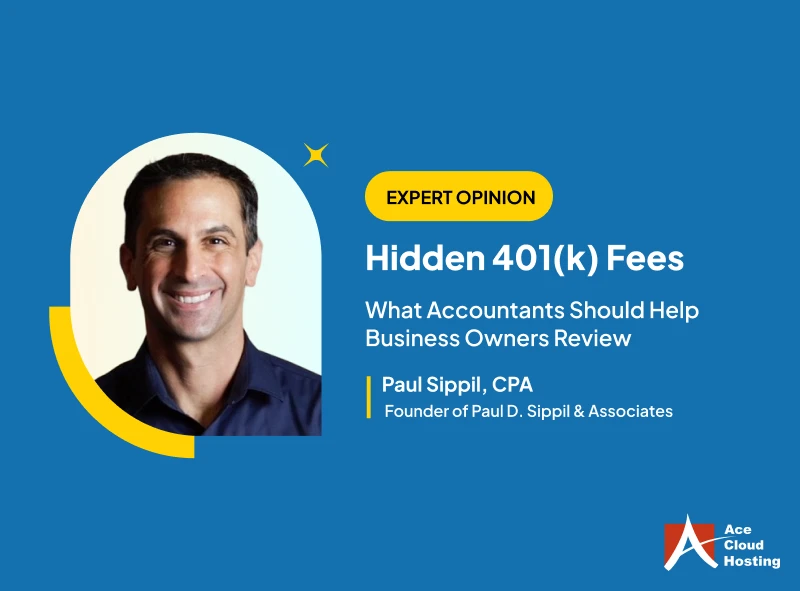
To explore what accountants and business owners should examine, Ace Cloud Hosting spoke with Paul Sippil, CPA, Founder of Paul D. Sippil & Associates.
Since 2009, Paul has focused on uncovering hidden fees and conflicts of interest within the 401(k) industry.
He has reviewed thousands of Form 5500 filings and documented more than 7,000 conversations with employers, building a detailed understanding of retirement-plan compensation, services, governance, and provider relationships.
In this conversation, Paul explains why plan costs are so difficult to understand, which fees are commonly overlooked, how accountants can use Form 5500 filings and plan documents, and what employers should ask before deciding whether their retirement plan is priced fairly.
Q1. Why do so many business owners assume their 401(k) plan is fine without ever knowing what it truly costs?
This is mainly because the 2012 fee disclosure rules produced a convoluted document that few retirement plan sponsors know about, and those that do have a difficult time understanding what any of it means.
It’s also because service providers, with the exception of the administrators who charge the smallest portion of the service fee, rarely, if ever, send invoices to reflect participant fees in actual dollars.
Q2. What are the most common hidden or overlooked fees inside retirement plans, and who usually ends up paying them?
The primary overlooked fees are record-keeping, administration, and advisory fees, and it’s almost always the participants who pay them.
Q3. Why can percentage-based advisor fees become expensive as plan assets grow, even when the services provided stay the same?
Even if the value of the investments remain the same, the participant and employer contributions still push up the total asset value, thereby increasing the service charges without a corresponding increase in services. Granted, the market can of course go down, but that’s hardly happened at all since 2008, so the past 18 years have produced extremely disproportionate increases in service charges.
Yes, the percentage does often decline as the assets grow, but the fees in dollars still increase.
Q4. How can accountants use Form 5500 filings and other plan documents to help clients spot potential fee and fiduciary issues?
They can look at the total fees being charged not only in proportion to the assets, but also in proportion to the number of plan participants, to ensure the services provided are reasonable in proportion to what is being charged.
They can look to make sure that there is a sufficient fidelity bond in the amount of at least 10% of plan assets up to a maximum required amount of $500,000.
They can also look at the plan design and make sure the plan is participant-directed, which can limit liability, and if the plan is set up to have participants auto-enrolled, that there is a qualified default investment alternative.
Q5. What questions should a business owner ask their retirement-plan provider or advisor before deciding whether their plan is priced fairly?
The most important question is how many hours you have spent each year servicing our account.
It’s also helpful to ask exactly what these hours consist of. Very few advisors are held to this standard, yet every other professional services provider faces this kind of scrutiny, so advisors shouldn’t be exempt.
Better 401(k) Decisions Start With Fee Visibility
Paul’s perspective highlights a fundamental problem with retirement plans. Employers are expected to evaluate providers and fulfill fiduciary responsibilities without receiving the same clear pricing information they would expect from most other professional services.
When fees are deducted directly from participant accounts, business owners may never see the total cost expressed in dollars. Percentage-based compensation can also rise as plan assets grow, even when the services being provided remain largely unchanged.
Accountants can help bring greater discipline to the review process. Form 5500 filings, fee disclosures, service agreements, plan-design documents, and fidelity-bond coverage can provide important information about how a plan operates and whether costs appear reasonable relative to its assets, participant count, and services.
Advisory work like this depends on accountants having reliable, secure access to their tools and client data from anywhere. Ace Cloud Hosting helps accounting firms host QuickBooks, tax software, and other critical applications in the cloud, so teams can focus on higher-value client conversations instead of managing infrastructure.
Securely access QuickBooks, tax software, and client data from anywhere with fully managed cloud hosting.