
Table of contents Toc Icon
Table of contents Toc Icon
In the fast-paced world of corporate finance, waiting on payments is more than just an annoyance—it is a drag on business growth. For years, Accounts Receivable (AR) departments have relied on manual entry, rigid rules-based software, and numerous follow-up emails to maintain a steady cash flow. But a shifting economic climate is forcing a change.
According to a recent market intelligence report prepared by Wakefield Research for Billtrust, a 95% of finance leaders report increased pressure to protect and secure cash flow amid current macroeconomic uncertainty.
To make matters more challenging, 80% of these professionals are being asked to do more with less, even though investments in traditional AR tools haven’t kept pace with their team’s demands.
These challenges have led companies to reinvent their cash management strategies with AI. The data show that AI is no longer a tech trend. It is playing an active role in helping businesses process payments, manage risk, and optimize human capital — a shift already reflected in how accountants are embracing AI and advisory services to fuel growth.
Let’s examine the Wakefield research report to understand the impact of AI on accounts receivable.
1. Slashing DSO and Boosting Cash Flow Predictability
The most important metric for an Accounts Receivable team is Days Sales Outstanding (DSO) – the average number of days it takes to collect a payment after a sale is completed. If DSO is too high, it increases the working capital locked up in operations. On the other hand, a low DSO reduces the requirement for working capital, making the business liquid and agile.
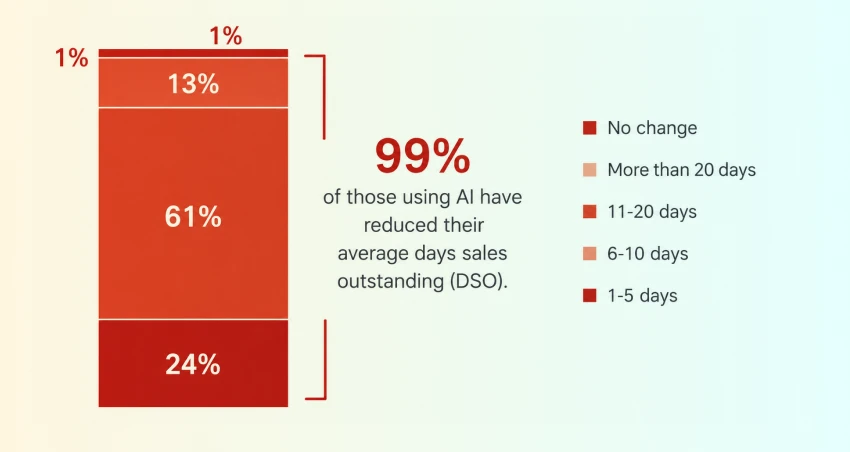
The report highlights that AI can have an immediate and positive impact on DSO. 99% of finance leaders surveyed have significantly reduced their average DSO with the help of AI. Furthermore, if we look at the breakdown of these numbers, it shows how much of an impact technology can have:
- 75% of the companies surveyed reported reducing their DSO by at least 6 days.
- 24% of the companies surveyed stated that they had achieved a reduction of 1 to 5 days
- 14% of the companies surveyed reported reducing their DSO by more than 11 days.
AI can even go beyond speeding up collections and act as a buffer against financial instability. Almost half of the companies surveyed (43%) reported improved cash flow predictability after introducing AI into their processes.
A well-managed and predictable cash flow gives finance leaders more confidence and helps them make better decisions, such as paying down debt, and navigate market fluctuations without worrying about a sudden cash crunch.
2. Where AI Adds the Most Value in AR Workflows
AI is highly efficient at cutting down manual work. Accounting firms feel AI is best utilized in data analysis and automation tasks that can take several hours of manual work. For firms looking to identify which workflows to automate first, this practical AI guide for accounting firms walks through where to start.
The top 4 ways AI is being utilized to reduce manual burdens include:
- Monitoring for Behavioral Anomalies (47%): AI can be used to scan a lot of data to develop an understanding of normal activity and flag any unusual activity that significantly deviates from the usual pattern. Any such sudden changes will be flagged and highlighted before they become a serious issue.
- Confidence-Based, Machine Learning-Driven Cash Application (47%): Traditional systems find it difficult to match a payment to an invoice if the data is incomplete or has typos. AI uses confidence-based matching to automatically match payments, learning from past human input to continually reduce manual follow-up work.
- Real-Time Credit Worthiness Monitoring (46%): It is crucial for accounting firms to closely monitor their clients’ financial health and creditworthiness. Conventionally, they rely on annual or quarterly credit reviews for this. AI constantly assesses client credit health, protecting the business from high-risk accounts in real time.
- Predictive Payment Forecasting (46%): AI can identify trends or patterns by analyzing past data. Given sufficient historical data of client behaviors and economic trends, AI can forecast when specific invoices are likely to be paid, leading to a predictable cash flow.
Furthermore, many accounting firms and other businesses are finding success using AI for automated invoice generation (45%), data validation (44%), and even deploying Agentic AI to handle standard collections calls (41%).
3. Scaling Operations Without Adding Headcount
Traditionally, accounting has involved a significant amount of manual work. To scale up, firms would need to hire more people to process higher volumes of work. AI has turned this notion on its head. See real-world examples of how accounting firms use AI to scale across cash forecasting, client communication, and compliance.
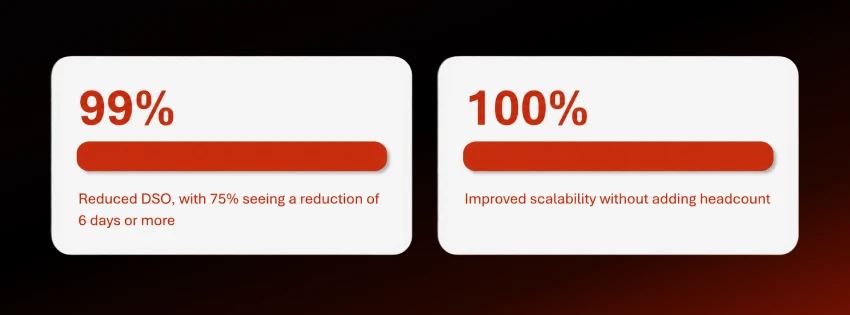
The report highlights that 100% of companies utilizing AI improved their operational scalability without adding headcount. Furthermore, 82% of these organizations scaled their AR operations by 11% or more purely through tech-driven efficiencies.
This shift is significant because 90% of business leaders acknowledge that without AI, their company’s AR processes cannot scale and deliver expected financial results. Relying solely on manual labor to manage growing invoice queues is no longer a practical business strategy.
Move your accounting workflows to a secure cloud platform built for automation, performance, and growth.
4. The Human Element: Freedom to Focus on Strategy
A common criticism of AI is that it will replace humans. However, historical data available so far show a different outcome of AI adoption. Instead of replacing humans and eliminating jobs, AI reduces workload and frees up time, allowing accounting professionals in AR to devote more time to improving DSO and other parameters by leveraging insights from historical data analysis. This shift is exactly what industry voices are highlighting in their take on what AI really means for accounting and tax pros.
When asked where they would redirect the time saved by AI automation, accounting firms prioritized several strategic areas:
| Strategic Activity | Percentage of Leaders Prioritizing |
|---|---|
| Enhancing compliance and risk management | 62% |
| Analyzing financial data and forecasting | 57% |
| Strategic planning and process improvement | 55% |
| Training and developing team members | 52% |
| Building stronger customer relationships | 50% |
By allowing software to handle the monotonous tracking and matching, companies can transform their AR departments from back-office administration centers into forward-looking, strategic units. These strategic units can actively improve customer satisfaction and mitigate corporate risk.
5. The Roadblocks to Full AI Adoption
Although there is sufficient evidence of AI’s overwhelming benefits, accounting firms are wary of full automation. At present, only 45% of firms describe their current AR setup as mostly or significantly automated.
A large majority of firms (97%) acknowledge that their AR workflows still need updates or investments to fully meet business needs. So, what is the reason for this slow adoption?
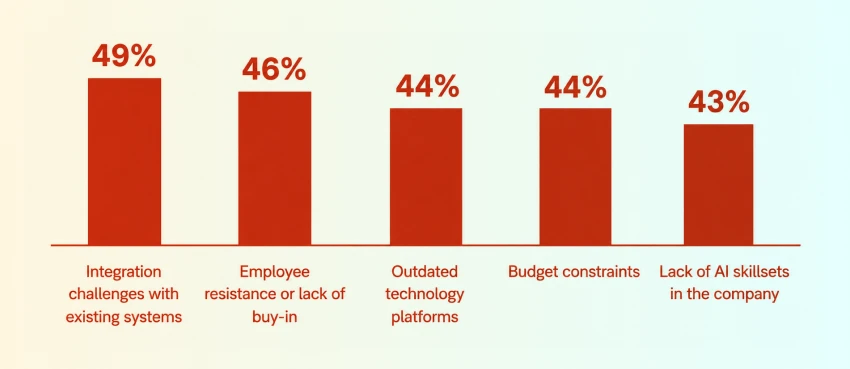
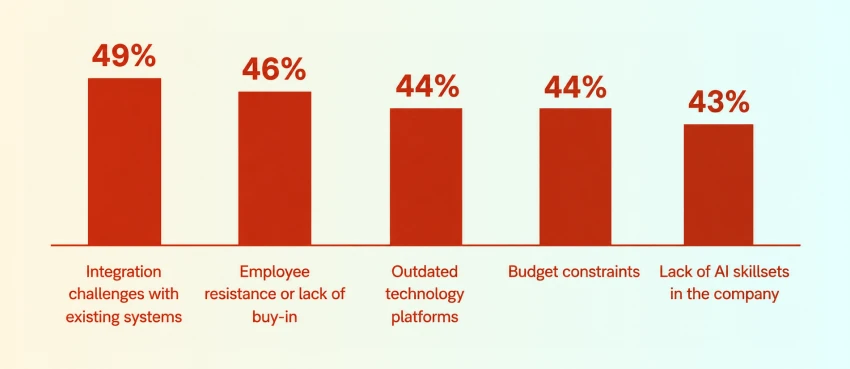
Leaders point to a few major roadblocks:
- System Integration Challenges (49%): Most firms are using some digital tools and platforms. Merging or integrating new AI tools or software is not an easy task and requires significant time and resources. Not every firm is willing and able to do it all at once.
- Employee Resistance and Mindset (46%): Another big hindrance is human resistance to change. 89% of people surveyed believe they will never fully capitalize on AI until their teams shift their mindset regarding how they work alongside technology.
- Outdated Technology Platforms (44%) and Budget Constraints (44%): Adopting AI on top of legacy digital infrastructure poses significant challenges and requires substantial investment. Not every firm has the financial capacity to allocate sufficient funds to accelerate necessary modernizations.
- Lack of AI Skillsets (43%): AI is still a relatively new field, and internal talent with the necessary skills to oversee and manage advanced AI models remains scarce.
Beyond these operational barriers, firms also need to weigh the AI risks accounting firms must address, including data privacy, compliance, and unauthorized access to sensitive client information.
6. Balancing Trust, Safeguards, and Human Oversight
Though AI has proven to be highly beneficial, organizations are still skeptical about complete AI adoption. Leaders in the accounting industry are optimistic about AI, but they are not throwing caution to the wind; instead, they are approaching it with deliberate caution.
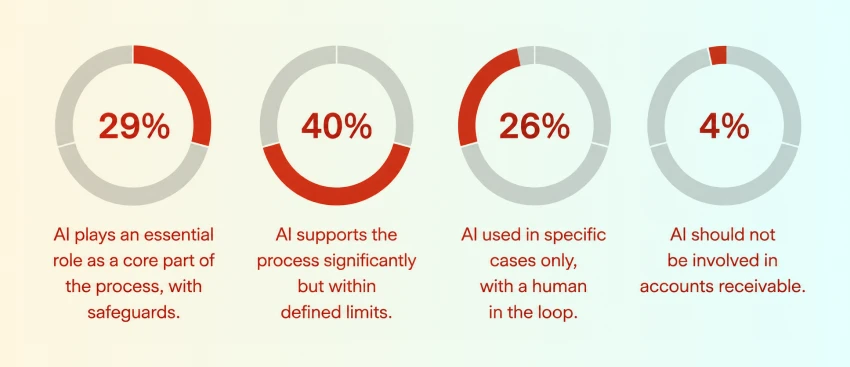
The survey categorizes how leaders at accounting firms view the future role of AI in AR automation:
- The Pragmatists (40%): A large number of accountants believe AI should support the process significantly but operate strictly within clearly defined limits.
- The Advocates (29%): This group believes AI should play an essential, core role in operations, but with robust safeguards firmly in place.
- The Skeptics (26%): A sizable but smaller number of accounting firms take a very cautious view, feeling that AI s only has some specific use cases and should always be validated and monitored by a human.
- The Opponents (4%): A tiny fraction of the firms surveyed believe AI has no place in accounts receivable at all.
This collective caution is why 97% of respondents agree that fact-checking AI-generated work will become a core operational task in the future. While 64% of managers are perfectly comfortable letting AI draft invoices or generate emails, they still want a human eye to review the output before it is officially sent. Only 24% are comfortable letting AI take actions completely unchecked.
Final Thoughts: The 12-Month Outlook
The corporate consensus is undeniable: AI is no longer a luxury—it is becoming a baseline requirement for financial efficiency. Driven by economic pressure and the clear benefits of faster payments, 71% of finance leaders plan to increase their investment in AR-focused AI over the next 12 months. For companies that have already actively implemented AI, that enthusiasm jumps even higher to 76%.
Overcoming system integration hurdles and shifting internal company mindsets will take time. However, the companies that successfully pair AI automation with human oversight will find themselves with superior liquidity, happier customers, and a highly scalable business model ready to weather any economic storm.