Table of contents Toc Icon
Table of contents Toc Icon
Client payment workflows often break quietly before firms realize there is a larger problem. Checks get delayed, ACH payments move slowly, invoices sit in inboxes, approvals depend on manual follow-ups, and reconciliation becomes harder than it should be.
For accounting firms, these issues do not stay with the client. They show up as reporting delays, cash flow confusion, cleanup work, and extra back-and-forth during month-end close.

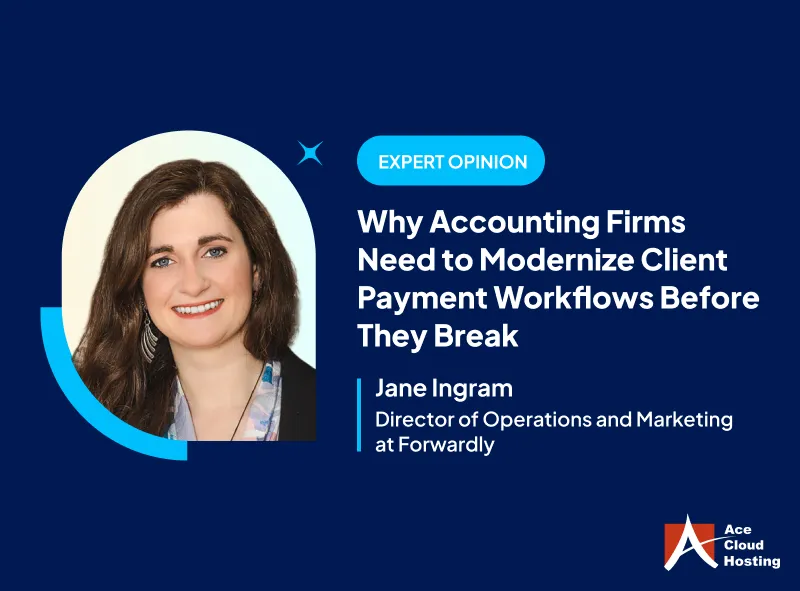
To explore why accounting firms need to modernize payment workflows before they break, Ace Cloud Hosting spoke with Jane Ingram, Director of Operations and Marketing at Forwardly.
With more than a decade of experience across SaaS, fintech, manufacturing, and operations, Jane brings a practical view of how firms can turn payment friction into cleaner, more reliable workflows.
In this conversation, Jane explains the risks of relying on checks and manual payment processes, the warning signs of broken AP and AR workflows, and how automation and AI can help firms improve accuracy without adding unnecessary complexity.
1. Many small businesses still rely on checks, slow ACH, and manual payment processes. From a best-practice standpoint, what risks does this create for accounting firms and their clients?
The risks from checks and older payment methods are higher than most people realize.
When a client is still running payments manually, the accounting firm ends up absorbing a lot of the fallout: reconciliation errors, late payments that skew cash flow reporting, and constant back-and-forth trying to match what’s in the books to what actually moved through the bank.
Checks are a particular problem because check fraud has continued increasing even as cheaper payment channels have gotten more secure. There’s another less visible risk, which is the opportunity cost. Every hour a client spends managing manual payment processes or cleaning up the aftermath of something going wrong is an hour not spent on better things.
2. What are the common warning signs that a client’s payment workflow is becoming too manual, slow, or difficult to manage?
Whenever I create a new operating procedure, the first thing I think is, “Will this still be efficient if I have to do it 100 times?” It’s no different when it comes to payment workflows or procedures.
The clearest sign of outdated or unmanageable payment processes is when reconciliation is painful rather than a simple review. If the books are consistently out of sync with the bank account, or month-end close is taking longer than it should, I see that the payment workflow is usually the culprit.
There are other warning signs, too. Like clients who can’t tell you what’s outstanding at any given moment, AP teams manually filling in bill details, and invoice bill payment approvals living entirely in someone’s email inbox. If a payment deadline has ever passed because an invoice got buried or lost, that’s a workflow problem tied to underutilizing readily available automation tech.
3. What practical steps can firms take to help clients modernize AP and AR workflows without disrupting their day-to-day operations?
Start with the part that hurts most, rather than trying to overhaul everything at once. For most clients, that’s going to be AP, specifically invoice capture and approval, or AR, specifically collections and reconciliation. Sometimes the pain point is something different, like paying high fees.
Pick one issue, identify a fix, get it working, and let the results make the case for the next step. It doesn’t have to be a huge change, either. One firm I worked with was still manually entering PDFs and running approvals via email and texts.
There were constant errors and late payments. They signed up to Forwardly, sent their vendors their new unique bill inbox email address, and within a month, all bills were extracted and coded with 99% accuracy thanks to our AI bill capture.
Once they had that running smoothly, they set up layered approvals for bills, so that expenses could be approved and paid by different team members depending on the client, vendor, and bill amount. Everything surrounding bill payments got easier for them.
4. Where do AI and automation fit into modern payment workflows, and what should firms watch for to ensure these tools improve accuracy instead of adding complexity?
I think AI is most useful at the point of data entry and anomaly detection, which are basically the two places where humans are most likely to make mistakes and least likely to catch them. This means bill capture that extracts data from invoices and codes them, which automatically removes a major source of error before it reaches the approval stage.
Add an AI Agent that knows your transactional history and monitors new transactions for duplicates or unusual amounts, and now you can easily catch things that slip through even careful human review.
The biggest note I have for firms looking to use AI tools is to look at the data first. The firms that struggle with AI adoption are usually the ones that tried to automate before they did any kind of cleanup. Remember, AI doesn’t fix bad data; it amplifies it.
If you start with garbage data, you’re going to get garbage results, and fixing that can be a special kind of mess. So, get the accounting system reasonably clean first, then layer automation on top.
5. For firms advising small business clients, what is one payment workflow best practice they should encourage clients to adopt this year?
Set up automatic payment collection for recurring clients. If you have customers, you invoice every month; those invoices should not require manual follow-ups, ever. Setting up automated collections, where the payment request goes out automatically, and reminders run in the background until the invoice is paid, removes the biggest drain on AR teams.
It also changes the client relationship in a subtle but definitely meaningful way: if payment is handled automatically and professionally, it stops being an awkward conversation and becomes just part of how you work together.
Empower your firm with secure access, seamless collaboration, and reliable performance to support modern AP and AR workflows.
Fix Payment Workflows Before They Slow Growth
Jane’s insights make one thing clear: payment workflows directly affect accounting accuracy. When payments are slow, manual, or poorly tracked, firms face reconciliation issues, delayed reporting, and unnecessary client follow-ups.
The best approach is to start small. Firms can fix the area causing the most friction, whether it is invoice capture, approvals, collections, or reconciliation, and then build from there.
For accounting firms, the goal is not just faster payments. It is cleaner data, fewer delays, stronger client visibility, and more time for advisory work. With secure cloud solutions, fully managed virtual desktops, managed IT services, and AI-powered cybersecurity, Ace Cloud Hosting helps firms create the technology foundation needed to support modern, reliable accounting workflows.