Table of contents Toc Icon
Table of contents Toc Icon
Sage Intelligence reporting and Sage Enterprise Intelligence are reporting solutions offered by Sage that are compatible with its range of products. However, both are a good fit for specific situations. They both differ in terms of functionality and feature set.
Sage Intelligence is made for people who are familiar with basic formulas and Excel, and Sage Enterprise Intelligence is built for business and even non-technical users.
Let’s take a deep dive to understand the best solution for your business.
What is Sage Intelligence Reporting?
Source: Sage
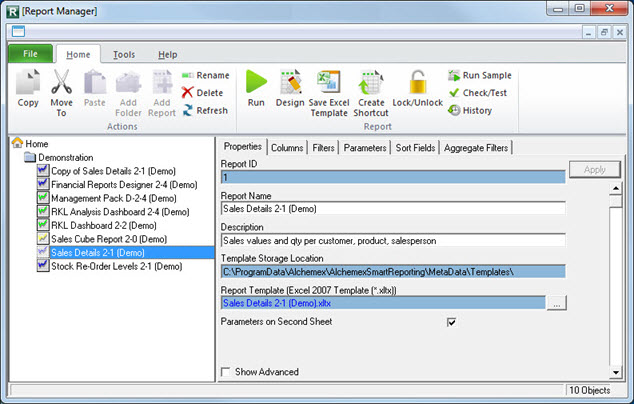
Sage Intelligence brings accounting data from Sage 300 in real-time and feeds it into MS comprehensible Excel templates, which can be viewed and customized. Users can further dissect the data, find insights from Excel templates, and prepare reports.
What is Sage Enterprise Intelligence?
Source: Sage
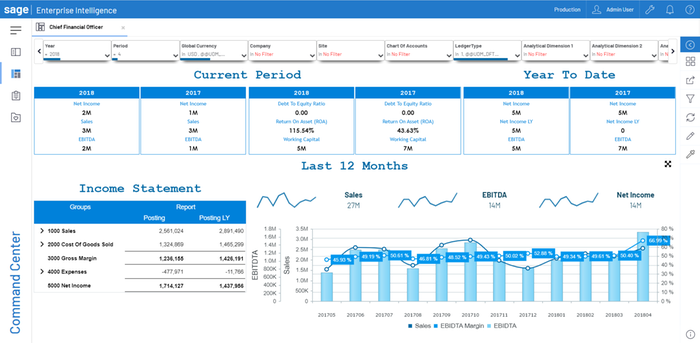
Sage Enterprise Intelligence provides a visual approach to reporting financial and operational data from Sage 300. This product allows even business or non-technical users to perform advanced analysis of Sage 300 data. This product is the brainchild of a third-party owner who is given access to Sage customers via an agreement.
Suggested Read: Moving Sage Fixed Assets to the Cloud – What You Need To Know?
How Do Both Solutions Differ?
It must be remembered that both products are made for Sage 300. However, both differ in terms of functionality. Sage Enterprise Intelligence provides more advanced features than Sage Intelligence.
Sage Intelligence Reporting is primarily based on Excel. That’s not the case with Sage Enterprise Intelligence. The solution is web-based. Users without any Excel background can use the intuitive interface to create reports. Moreover, you can access Sage Enterprise Intelligence from any device.
Sage Intelligence is enough for small to medium-sized businesses. Still, it lacks the cadence to scale for larger enterprises with big infra and set up where systems are fragmented.
Enterprises that need a better understanding of their data should go for Sage Enterprise Intelligence. Sage Enterprise can be used in all areas, such as inventory control, quality control, etc.
Here are some ways in which both solutions differ:
Interface
As mentioned earlier, Sage Intelligence Reporting is purely Excel-based, while Sage Enterprise Intelligence is web-based. This means that Sage is quite easy to use in terms of functionality.
Sage Intelligence Reporting is user-friendly and designed for both technical and non-technical users. Its interface supports drag-and-drop features that allow extensive data visualizations.
Data Integration
Sage Enterprise Intelligence can be connected to multiple data sources and has been built with Live Data features. Data integration is possible with Sage Intelligence Reporting with specific licenses.
The cost increases with the connector licenses for other systems. Sage Enterprise Intelligence is integrable with Sage ERP systems and also with other data sources. This advantage is not available in Sage Intelligence Reporting.
Get secure, high-speed access to Sage 300 from anywhere. Host it with Ace Cloud Hosting and simplify your accounting operations.
Data Security
In Sage Intelligence, Security features to run reports can be assigned only at a report level. Report Managers can design reports using this solution. That’s not the case with Sage Enterprise Intelligence security features, which can be deployed on a specific user group, user, particular report, and field level.
Functionalities
Sage Intelligence offers basic reporting and pre-built reports that require customization for financial experts. However, Sage Enterprise Intelligence offers advanced analytics, complex reports, dashboards, and data mining. It is easy to slice & dice, drill down data, or filter and group queries and formulas.
Data Sharing and Collaboration
Sage Intelligence Reporting is built with visualization capabilities. It provides dashboards, cross tabs, pivot tables, and Excel chart formats. The same features are present in Sage Enterprise Intelligence. However, there are some add-ons like gauges, maps, and advanced chart formats.
Templates
The Sage Intelligence Reporting solution only provides income statements and balance sheets templates. However, you need to create additional report templates in it. Sage Enterprise Intelligence also provides templates for financials, inventory control, sales, customer service, purchasing, and production.
Reporting
Sage Intelligence supports Excel-based reports. Reports on non-GL modules and multiple data sources can be created with a connector license. However, Sage Enterprise Intelligence supports real-time reporting on any data source. It can be easily connected with any data source.
Accessibility
Sage Intelligence reports can be accessed only from the main system. However, Sage Enterprise Intelligence can also be accessed from mobile phones, tablets, and other devices.
Data Accuracy
Reporting on Sage Enterprise Reporting is on a real-time basis. On the other hand, Sage Intelligence only provides a snapshot of reports when the reports are running.
Sage Intelligence reports Budgeting information from Sage 300 only. Sage Enterprise is capable of generating live reports. These reports can be shared with other teams with the help of the Automate Reporting Schedule.
Suggested Reading: How Hosting Sage 300 ERP on Cloud Helps You to Manage Your Business from Anywhere?
Which Is Better for Your Business?
It is the requirement or business need that should be evaluated before picking the solution for your case. Small to medium-level organizations that need basic reporting features should opt for Sage Intelligence Reporting. However, large enterprises that need advanced analytics and better data drill-down should select Enterprise Intelligence for their business.
The advantage of Sage Intelligence is that it comes bundled with the Sage 300 software license. However, the Manager, Designer, Connector, & Analysis modules require a further cost. Sage Enterprise Intelligence is a third-party solution. So it needs to be purchased separately.
Some businesses might think that built-in reports are not enough to get a deeper view of the report. Sage Enterprise Intelligence is built for them. Sage Enterprise Intelligence is more nimble – it produces faster outputs using online analytical processing (OLAP) for the largest data sets.
It bundles a powerful engine that drives the extraction of real-time insights for quick decision-making. Its makers claim that users can be trained on Sage Enterprise in just one day to derive actionable intelligence.
The self-service reporting solution is fast and allows business users to analyze piles of data in real time without missing anything. Features like a search engine and an active directory are also present in the system. This means businesses spend less time sifting through the data and more time analyzing it.
Ace Cloud Hosting delivers fast, reliable Sage 300 performance—backed by 99.99% uptime and expert support, 24/7.
Conclusion
Sage Intelligence is a powerful reporting tool, but it’s not always enough. It’s not best when your teams are spending more time pulling together fragmented spreadsheets than analyzing insights.
With Sage Enterprise Intelligence, users derive high-value, actionable insights from large data sets via a customized dashboard. Its pre-built templates, real-time data access, and automation features make it an ideal choice for scaling businesses that want more from their data without complexity.