Table of contents Toc Icon
Table of contents Toc Icon
In today’s fast-moving business environment, the role of a Certified Public Accountant (CPA) is evolving far beyond routine compliance and accounting work.
In fact, 86% of small business owners regard their accountant as a trusted advisor. However, only 53% firmly underscore that role, signifying a gap between perception and truly advisory value.
When accountants shift from mere number crunching to proactive counsel, client satisfaction significantly increases, rising to 88% when their service reaches the “trusted advisor” level, according to the CPA Practice Advisor report. This shift isn’t just about better service; it’s about becoming indispensable.

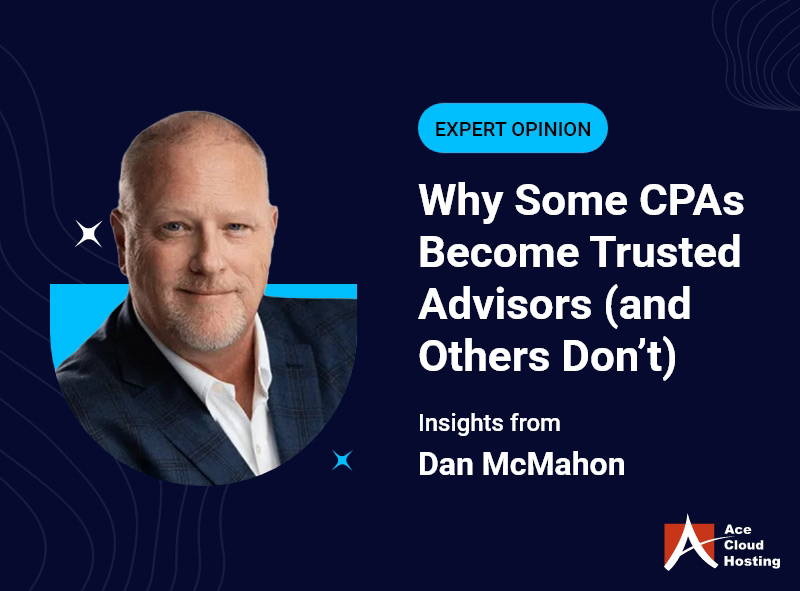
To explore this transformation, Ace Cloud Hosting spoke with Dan McMahon, Founder and Managing Partner of Integrated Growth Advisors. With over 25 years of experience as a CPA and business advisor across Chicago and New England, Dan has helped business owners strengthen governance, ensure asset sustainability, and drive long-term value creation.
Before founding his firm, Dan served as Audit Partner and Partner-in-Charge of Sales and Marketing at a $30 million regional accounting practice, where he specialized in governance and controls.
Today, he focuses on corporate governance, generational transitions, and M&A advisory, always with an eye on building equity value. His blend of technical expertise and advisory insight makes him a compelling voice on what truly separates a standard CPA from a trusted advisor.
Q1. In your view, what separates a CPA who is simply an accounting professional from one who becomes a trusted advisor to their clients?
A CPA who is simply an accounting professional is focused on the past — reporting, compliance, and making sure the books balance. A trusted advisor helps clients connect financial data with business decisions, future opportunities, and risks. The separation usually comes down to this: Are you content to be the tax guy/gal? Or do you see yourself as an integral part of the client’s leadership team?
Trusted advisors don’t just answer the question in front of them; they ask better questions. They translate numbers into clarity, action, and strategy that ultimately improve the client’s bottom line. Clients value that kind of perspective because it helps them make decisions with confidence — and confidence is ultimately what they’re buying.
Q2. How important are communication and relationship-building skills compared to technical expertise in earning that “trusted advisor” status?
Technical expertise gets you in the door — no client is going to trust an advisor who doesn’t understand tax, accounting, or audit at a high level. But communication and relationship-building are what keep you in the room. Most business owners aren’t accountants; they need complex issues explained to them in layman’s terms, free of jargon.
They also need to know that their CPA understands their goals as an owner, not just their numbers. Trusted advisors listen first, translate second, and guide third. I’ve seen highly technical CPAs fail to become advisors because they couldn’t connect with clients. Conversely, CPAs who build strong relationships — while grounding their advice in technical soundness — become indispensable.
For example, back in my practicing days as a CPA, my firm picked up a substantial tax client – a successful business owner whom we billed in excess of $20,000 per year. Soon after we started working together, the client told me over lunch at his golf club that he had recently terminated his previous CPA.
Apparently, my client and his former CPA had just finished a round of golf. Throughout the round, the CPA kept telling my client how he could improve his P&L by tightening his expenditures in mundane areas such as postage, shipping, office supplies, etc. The former CPA misread the room, and my client terminated him because he missed the opportunity to build trust. He missed the fact that a day of golf was about enjoying each other’s company and building a relationship.
My client’s story was a little chilling to me, but it helped me understand that my client sees the big picture and expects me to see the big picture, too. It helped me realize that, as CPAs and business advisors, sometimes we have to put calculators and spreadsheets away and focus more on what makes people tick. Understanding your client’s perspective and positioning in this world are key to earning the trusted advisor status.
From that day forward, I vowed to be the best advisory partner I could be for each one of my clients. In this circumstance, my client grew to rely on me as the advisor while one of my team members – a tax expert — handled the tax part of the engagement. I’m a passionate golfer.
Having worked in business development and client development roles for most of my career, I’ve learned one very important rule: Don’t exclusively discuss business with your clients, especially when there is an opportunity to advance your relationship.
Q3. What role does technology—like cloud and AI—play in helping CPAs move beyond number crunching to deeper advisory work?
Technology is both a challenge and an opportunity. Cloud platforms and AI tools are automating more and more of what CPAs used to bill for — compliance, bookkeeping, even tax prep. That can feel threatening, but it’s actually liberating. If technology takes care of routine tasks, CPAs are freed to focus on the conversations that matter most: strategy, planning, governance, long-term value creation, and relationship building.
AI can crunch the data, but it can’t yet sit across the table from an owner and say, “Here’s what this means for you and your family.” That’s where the human with an advisory focus comes in.
AI is advancing to a point where an advisor can take on hundreds of clients at one time, as opposed to the historical model of being able to manage only a handful. Technology can compile, organize, and even analyze client data in minutes, compared to the days or weeks advisors used to spend.
Imagine a dashboard of clients with key performance indicators drawing the advisor’s attention towards the one or two elements that are most important for any given client, and the AI system had already done the baseline analysis work. In fact, you don’t have to imagine this; it’s already happening, and we are using a tool to support us in this way.
The firms that embrace technology while repositioning themselves as forward-looking advisors will thrive. The ones that resist technology will slowly get commoditized and left behind.
Q4. From your experience, what mistakes hold CPAs back from being seen as strategic partners to their clients?
The biggest mistake I see many CPAs make is hiding behind the technical work. Too many CPAs think that if they produce accurate tax returns or financial statements, they’ve done their job. In reality, that’s just the starting point. The example I shared above comes to mind in that my role was to understand the big issues impacting my client and connect the strategic and tactical dots to facilitate his success. My capable team gave me the roadmap for discussing technical matters.
My job was to deploy a strong “bedside manner” in how I communicated and to bind the client to our firm through trust-building interactions. A great advisor always looks through the windshield (i.e., ahead), whereas accountants typically look through the rear-view mirror, trying to discern what happened in the past. I shared that viewpoint with a client, and my client keenly replied, “That’s why the windshield is much larger than the rear-view mirror!”
Another mistake is avoiding uncomfortable conversations about the business itself — governance issues, ownership transitions, or strategic blind spots. CPAs sometimes underestimate how much clients want someone to be honest with them, even if the truth is hard to hear. An effective advisor has the courage of his or her convictions, to lay things out as he or she sees them and persuade the client to act on what must be done.
A third mistake CPAs make is not being accessible during busy season, not returning calls, and not following through with clients. Those behaviors erode trust. Trusted advisors show up, return client calls promptly, communicate clearly, and focus on helping owners achieve their bigger goals, not just filing deadlines. That’s one of the important lessons we drive home with the firms we work with when helping them build stronger advisory practice and achieve optimal levels of performance.
Q5. What practices or habits have you seen in CPAs who successfully evolve into long-term advisors that clients rely on for more than just accounting, tax, or audit support?
The CPAs who evolve into long-term advisors tend to have these common attributes:
- They invest in continuous learning — not just technical CPE, but leadership, strategy, and communication skills, i.e., the “soft skills”.
- They ask questions that get to the heart of the business owner’s goals and pain points.
- They make themselves available and accessible, even when it’s inconvenient, because they know trust is built in the moments that matter. See Q4 above.
- They adopt planning cadences with clients — annual strategic sessions, quarterly (or trimester) check-ins, and metrics reviews — and they therefore remain in-step with the business.
They’re comfortable being part of the client’s decision-making process and leadership team, not just being a financial historian. Over time, that combination of accessibility, foresight, and honesty contributes to their evolution as an indispensable voice supporting the client’s pursuit of success and navigation of challenges.
The Future Belongs to Trusted Advisors
The most successful advisory relationships are built on accessibility, strategic thinking, and genuine relationship-building. Technology may automate routine work, but it cannot replace the human advisor who translates financial data into actionable insights and understands the business owner’s broader goals. The next generation of CPAs will first adapt and then transform into advisors who play a key role in the growth and development of their clients’ businesses.
Technology will continue to change the profession, automating tasks that once defined a CPA’s role. But no software can replace the ability to connect with a client, ask the right questions, or give honest advice when it matters most. The firms that thrive will be those where CPAs show up consistently, communicate clearly, and commit to helping clients succeed both in business and in life.
From automating workflows with AI to enabling real-time collaboration on accounting data and applications with Ace Cloud Hosting, accountants can become technology changemakers within their firms—evolving into strategic advisors rather than just CPAs.



![[Expert Opinion] How Accounting Has Evolved in the Era of AI: Insights from Phil Hobden](https://www.acecloudhosting.com/wp-content/uploads/2025/05/expert-opinion-from-phil-hobden.jpg)