Table of contents Toc Icon
Table of contents Toc Icon
Offshore accounting is no longer just a cost-saving strategy for CPA firms. When structured effectively, it can help firms expand capacity, improve turnaround times, and enable partners to focus more on client relationships, review, and advisory work. However, without the right processes, controls, and oversight, it can lead to operational confusion, security concerns, and quality gaps that may impact client trust.
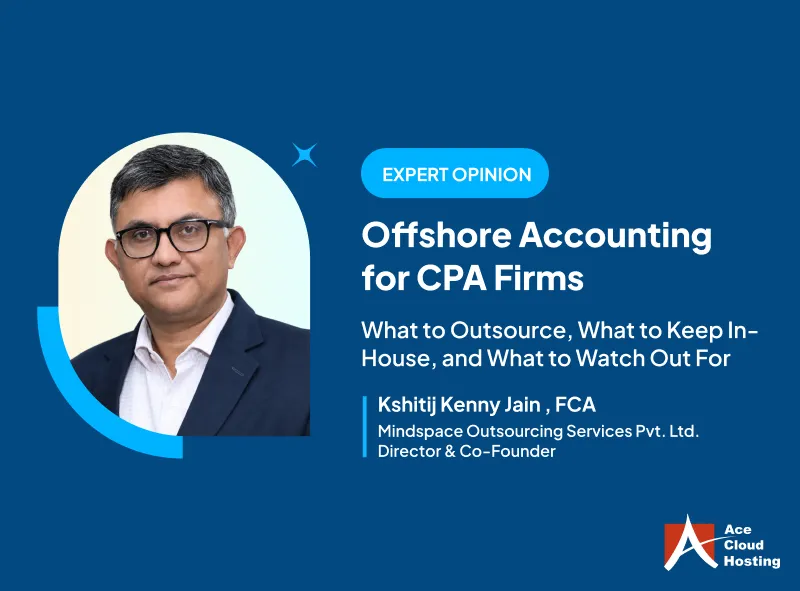
To explore what CPA firms should outsource, what they should keep in-house, and what they must watch out for, Ace Cloud Hosting spoke with Kshitij Kenny Jain, FCA, Co-founder of Mindspace Outsourcing Services Pvt. Ltd. A Top 50 International ProAdvisor in 2025, Chartered Accountant, and certified QuickBooks and Xero ProAdvisor, Kshitij brings more than 20 years of experience in global finance, outsourcing strategy, cloud accounting automation, and scalable delivery models.
In this conversation, he explains why successful offshore accounting depends on knowing the difference between execution and judgment, how firms should protect client data, and why offshore teams must now be cloud-native, AI-literate, and deeply connected to the firm’s workflows.
Q1. What accounting functions are best suited for offshore teams, and which ones should CPA firms keep closer to partners or senior managers?
After two decades of working with CPA firms across the US, the one thing I can say with complete confidence is this: the firms that get offshore right are the ones that understand the difference between execution and judgment.
Tasks that are process-driven, rule-based, and high in volume are genuinely well-suited for offshore delivery. Bookkeeping, bank and credit card reconciliations, accounts payable and receivable management, payroll processing, tax return preparation including 1040s, 1120s, and 1065s, and year-end closing entries all fall into this category. These are areas where skilled offshore teams can deliver real quality at scale, freeing up your local team to focus on what matters most.
What should stay in-house? Anything that requires owning the client relationship, exercising professional judgment, or navigating regulatory complexity. Tax planning conversations, complex entity structuring, quality review and sign-off, handling IRS notices, managing disputes and exceptions. These are moments where your client needs a trusted advisor, not just a competent processor, and that trust lives with your partners and senior managers.
A simple test I share with firms: if you can write a clear, repeatable process document for a task, it can almost certainly be offshored. If it requires reading a client’s mood in a meeting or making a judgment call that no checklist could capture, keep it local.
Q2. How should a CPA firm decide whether to offshore bookkeeping, payroll, tax preparation, AP/AR, reconciliation, or year-end accounting work?
The framework I use with firms comes down to three questions: How much volume is involved? How repeatable is the process? And how much risk does the firm carry if something goes wrong?
Bookkeeping and reconciliations are almost always the right starting point. The processes are well-documented, the output is straightforward to review, and the cost savings show up quickly and clearly on the bottom line.
Tax preparation, particularly individual returns and standard business returns, offshores exceptionally well when the firm has a clear review layer in place. At Mindspace, US tax preparation makes up a significant part of what we do for our partner firms. The ones who set up a clean prep-and-review workflow consistently see faster turnaround times and partners who are no longer buried in preparation work during peak season.
AP and AR management can be offshored successfully when the client relationship allows for shared or delegated access. Payroll also works well offshore, though firms need to ensure their offshore team understands federal requirements and state-specific compliance in detail. Year-end accounting, including trial balance preparation, adjusting entries, and draft financials, is widely offshored by the firms we work with. Partners stay focused on the final review and the client conversation, which is where their time genuinely belongs.
My honest advice: start with one function. Build the workflow, build the relationship, and build the trust. Then expand from there. Trying to offshore everything at once is one of the fastest ways to make the whole thing fall apart.
Q3. What are the biggest mistakes CPA firms make when they start working with offshore accounting teams?
I have seen hundreds of these relationships over the years with CPA firms, some that became genuine long-term partnerships and some that fell apart within months. The difference almost always comes down to the same five mistakes.
The first is treating the offshore team like a vendor rather than an extension of the firm. When firms keep their offshore team at arm’s length, share minimal context, and skip the onboarding investment, they get generic output. The firms that genuinely succeed share client history, firm preferences, and style guides. They bring the offshore team into the culture, not just the task list.
The second is having no defined review layer. Offshore work needs a review workflow before it reaches the client. Firms that skip this step create avoidable errors and, over time, real reputational damage.
The third is expecting perfection from day one. Every new outsourcing relationship has a calibration period. Firms that give clear, specific feedback consistently in the early months unlock dramatically better output. The ones that give up at the first imperfection miss what could have been a very strong long-term arrangement.
The fourth is having poorly documented processes. The quality of your SOPs is the single biggest factor in offshore success. If your own team struggles to follow your processes, an offshore team will too.
The fifth is having no single dedicated point of contact. When multiple people are sending ad-hoc work with no structure or priority order, it creates confusion and low accountability on both sides. One internal owner changes everything.
Q4. How can CPA firms protect client data and ensure confidentiality when outsourcing accounting work offshore?
This is the question I take most seriously, and I think every CPA firm should too. Client confidentiality is not a compliance checkbox. It is the foundation of the trust that every accounting practice is built on, and in the US, it also carries very real legal and professional liability implications.
At Mindspace, we have spent years building a security framework specifically designed to meet the expectations of US accounting firms and their clients.
It starts with NDAs and contractual protections that go beyond the entity level. Every individual team member who handles client data should be personally bound by a confidentiality agreement. This is non-negotiable.
Access controls need to follow a least-privilege model, where offshore staff can access only what is required for the specific client they are working on and nothing more. Role-based permissions, two-factor authentication, and VPN-controlled environments are the baseline, not the ceiling.
Work should happen inside cloud-based delivery environments or firm-managed portals that firms are already comfortable using. These create controlled, auditable workspaces where sensitive client data never needs to travel through email or unsecured channels.
Data residency and handling policies should be explicitly agreed upon before work begins. Firms should know exactly where their client data is stored, who can access it, and what happens in the event of an incident.
And finally, ask your provider for evidence. Ask to see their ISO 27001 certification, their SOC 2 report, or an equivalent. A credible offshore partner working with US firms will have these readily available. If they cannot produce them, that matters more than any pricing advantage they might offer.
Q5. How can CPA firms manage communication, time zone differences, and turnaround expectations with offshore teams?
Time zones are probably the most cited concern I hear from firms considering offshore for the first time. And I always give the same response: managed well, the time zone difference is not a problem. It is actually one of the biggest advantages of the model.
A US-based firm working with an India-based offshore team has a near-24-hour production cycle available to it. Work sent at the end of the US business day can be ready for review the next morning. During tax season, when every hour counts, that kind of overnight throughput is a genuine competitive edge and the US firms who lean into it see it clearly in their turnaround times.
The key is building the right structure around it. Brief daily or weekly video calls focused on priorities and blockers are more than enough to maintain alignment. A 15-minute overlap window handles the vast majority of operational needs.
For everything that is not urgent, async-first communication is the right approach. Using Slack, Microsoft Teams, or project management platforms to hand off tasks clearly means both teams can work at full productivity without depending on real-time availability.
Turnaround SLAs should be defined upfront and kept specific. Standard bookkeeping tasks within 24 hours. More complex US tax returns within 48 to 72 hours. Build those windows into your client-facing deadlines from the start.
Standardized intake templates make an enormous practical difference. When every job arrives at the offshore team with the client’s name, tax year, relevant documents, and any special notes already in place, the back-and-forth drops significantly, and quality improves consistently.
The last thing I would say is this: invest in the human relationship. Check in beyond the work. Celebrate milestones together. Teams that feel respected and genuinely valued consistently go the extra mile, and that is not unique to offshore teams. It is just how people work best.
Q6. How do you see offshore accounting evolving over the next few years with AI, automation, and cloud accounting tools?
This is the question I find most exciting to think about, because for CPA firms specifically, the opportunity ahead is enormous.
The honest reality is that AI and automation are not replacing offshore accounting teams. They are elevating what those teams can do. Transactional data entry, basic categorization, and routine reconciliation are already being handled significantly by tools like Dext, AutoEntry, and the AI-native features built into QuickBooks and Xero, which are widely used across US accounting firms. What this means is that skilled offshore professionals are being freed to move up the value chain, into review work, exception handling, analysis, and judgment-based tasks that technology still cannot perform reliably on its own.
For US CPA firms, the implication is clear: your offshore partner needs to be genuinely cloud-native and AI-literate. The firms that will have the strongest positions five years from now are the ones building relationships with offshore partners who operate fluently inside these tool ecosystems, not just as processors following instructions, but as skilled practitioners who know when to trust the automation and when to question it.
Recommended Reading: Joe Woodard Explains How Accounting Firms Can Transform in the AI Era
I also think the concept of offshore itself will gradually become less prominent as a category. What is really emerging is distributed delivery, which means flexible, outcome-based teams that work seamlessly across time zones and technology platforms. At Mindspace, this is the model we are actively building toward. Not staffing for the sake of headcount, but true outcome-based outsourcing where the US firm and its clients care about the quality and timeliness of the result, not the location where it was produced.
The US firms that invest in building this capability now, including the workflows, the oversight structures, and the right partnerships, will be in a significantly stronger position as the profession continues to evolve.
Host your accounting and tax apps on Ace Cloud Hosting to enable real-time access, stronger data protection, and seamless collaboration.
From Outsourcing Tasks to Building Distributed Teams
Kshitij’s perspective makes one thing clear. Offshore accounting works best when firms treat it as a structured delivery model, not a quick handoff of excess work. The right tasks are repeatable, process-driven, and supported by clear SOPs. The work that requires judgment, client trust, or regulatory interpretation should stay closer to partners and senior managers.
As AI, automation, and cloud accounting tools continue to reshape the profession, offshore teams will move beyond basic processing. The future is distributed delivery, where skilled teams work across time zones, platforms, and workflows to deliver consistent outcomes. CPA firms that build the right oversight, security, and partnerships now will be better prepared for that future.
At Ace Cloud Hosting, we help CPA and accounting firms move their accounting and tax applications to secure cloud environments that support distributed teams, real-time access, AI-ready workflows, and stronger data protection. Start your journey today!