Table of contents Toc Icon
Table of contents Toc Icon
The accounting profession is changing, and many firms are feeling it. What once worked as a compliance-driven model is no longer enough to meet evolving client expectations. Today, firms are expected to do more than complete tasks.
They are expected to guide decisions, offer clarity, and build deeper relationships. The challenge, however, is not ambition. It is confidence, structure, and knowing where to begin.
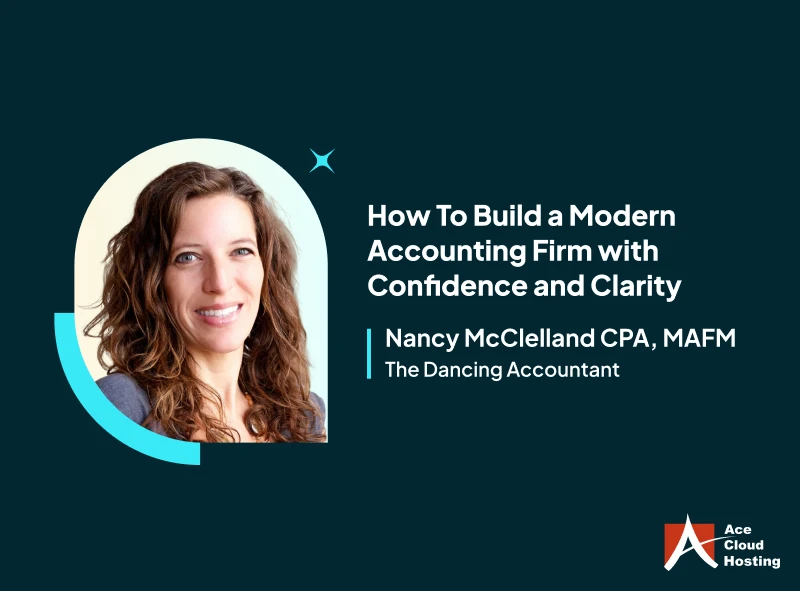
In this conversation hosted by Ace Cloud Hosting, Seth Fineberg, Founder of Accountants Forward, sits down with Nancy McClelland, CPA, also known as The Dancing Accountant, to discuss the future of modern accounting and why many professionals still hesitate to change, even when they know it is necessary.
Drawing from her experience building a fully remote, hyper-local firm, leading communities like Ask a CPA, and co-hosting She Counts, Nancy shares practical insights on how firms can move beyond compliance work. The discussion stays grounded in real-world challenges and focuses on the small, meaningful steps firms can take to evolve with confidence.
Video Transcript
Seth: I’m Seth Fineberg, and I am really excited today to talk to a good friend and colleague in the industry. Nancy McClelland, CPA, is often known as the Dancing Accountant. Dancing Nancy. Many titles for Nancy.
We’ve got a really great topic today, too. But, Nancy, why don’t you just introduce yourself really briefly to the folks?
Nancy: Seth, thank you so much for having me. You know, I’m a huge fan of the work that you do. And of course, a big fan of Ace Cloud Hosting as well. And so it’s just really lovely when you asked if I would help you out with this, and, for those who don’t already know me. Yes, the Dancing Accountant.
It’s not just a moniker. It’s actually the name of my CPA firm, a hyperlocal CPA firm, 25 years in our little neighborhood in Chicago. And, it’s kind of interesting because even though we’re a hyperlocal firm, we are also 100% remote and always have been.
And so I will pop in and meet with clients at their, you know, at their restaurants and their bars and their cafes and their stores. And it’s a lot of fun.
But my team is a team of nine of us. In all, I’m the only full-time person spread all across the United States. And, we have a really, really wonderful company culture, and we’re super proud of the work we do to keep our neighborhood vibrant and healthy. And in addition to that, I’ve got two pretty important projects which I know we’ll talk about a little bit.
I founded Ask a CPA, which is a community for bookkeepers who want to learn how to prepare tax-ready books. And I am the co-host of the “She Counts” podcast, Real Talk for Women in Accounting.
Seth: It’s fantastic.
Nancy: Yeah.
Seth: And it was that which was really something. So today, I think you are the perfect candidate to dive into this topic.
Nancy: Fantastic.
Seth: We want to talk about moving from technician to trusted advisor. Now, a lot of CPAs already feel like, well, this is why they do what they do. This is their role. But confidence is something that, I think, maybe you talked about on She Counts.
Building confidence and authority in modern accounting. Obviously, the profession right now is definitely at an inflection point. One of you knows, several that have happened over the past, like three decades or so, under my watch.
So, one central theme in our discussion here, you know, again, confidence, it’s a major factor that often keeps accounting professionals from making moves that they know they need to make, to improve their practices and consequently, their lives. Let’s be honest.
Nancy: Yeah. I couldn’t agree more.
Seth: You know, I know that you’ve seen this in a lot of your work with, you know, the members of your Ask A CPA community. Can you share with us, you know, where does that even begin?
Nancy: Yeah.
Seth: Where’s the starting point?
Nancy: You know, first, Seth, I just want to say thank you for having these conversations out loud where people can hear them, because I think we often feel like we’re the only ones with a lot of different things.
Confidence is one of them. Right like, we’re the only ones who don’t have confidence. And everybody else looks at that person out there on social media. Look at that person. You know, one thing is it’s like one of the most natural emotions ever to have that fear. And so I think when you say, where does it begin? It begins with realizing that confidence isn’t a personality trait.
It’s a byproduct. I believe it’s a byproduct of clarity. It’s a byproduct of education. It’s a byproduct of experience. And what I see inside as a CPA is that most professionals are not lacking ambition. It’s the sense of certainty that they’re lacking. So, like if you don’t know your right and you’re in our profession, being wrong can be really expensive, it can be a very bad thing.
You hesitate because you’re like, you’re not sure if you’re right or not. The shift toward confidence in my experience, both with the “Ask a CPA” members and with the conversations that we’re having on “She Counts”. The shift happens when we start asking better questions. We get grounded in like authoritative answers. We get to see that we have these conversations out loud, like what you’re doing.
We get to see how others think through similar situations. I know you, and I are both huge fans of the Bridging the Gap conference, and this is something they do really well. You write, you get a bunch of panelists up there, a bunch of people who are like really running their firms. And one of them says, well, I don’t know.
I didn’t know the answer. So, I solved the problem this way. And somebody else is like, well, I didn’t know the answer either. And so, I solve the problem this way. And somebody else says, well, I came up in a firm that solved it this way, but I knew I didn’t want to do it that way. I reacted against it.
Right. So, like so many different perspectives, it makes you feel less alone. It makes it so that you’re no longer guessing. Public speaking confidence isn’t a feeling. It’s something you learn by doing. And when we don’t feel like we’re faking it, great, we can lean into the professional relationships that we’ve built with clients who trust us.
And you can say, I don’t know the answer to that, but I’ll find out. And then you know that’s a kind of confidence.
Seth: Just saying those words out loud, hear yourself say that going. You know what I don’t know, but I’m going to find out.
Nancy: But I have a professional network, I have colleagues, I have resources, I’m not alone. I can find out. So, you learn by hearing these diverse perspectives. You learn by asking questions. You learn by being open and pushing through the fear to be able to say, I don’t know. And then you have the experience that the next time you get that question, you do know, and the next time you see a situation where a client might need advisory services, you’re like, hey, I can help. And we exercise that muscle.
Seth: Right, so you would mention that you do have some of these discussions on She Counts, on the podcast. So, what concerns have you heard from other practitioners who are comfortable, but, you know, enough red flags have gone off over the last sort of few tax seasons to know maybe it’s time to work better towards this idea of modern accounting.
Nancy: Okay, I feel really seen here because I am one of those people, right? Like my firm, we’ve been around for 25 years.
Seth: Right
Nancy: People are like, “Oh, you’re so progressive.” I’m like, oh, you have no idea how much legacy stuff we still have sitting around. We do.
Seth: Hiding the paper. Hiding the paper.
Nancy: Yeah. Well, no, we are really good about being paperless. I live in Mexico for four months of the year during tax season. That’s where I am right now. So we have to be paperless. That part I’ve got figured out. But there are other things I haven’t figured out, right? Nobody has everything figured out. It’s just impossible.
And so like I was saying earlier, you know, we’ve there are these diverse perspectives out there. And I listen to my colleagues, and I go, okay, well, this is something that is inefficient, or this is something that drives me crazy. What are my colleagues doing to fix these problems? And I ask for their help. And little by little over the years, things get better and better. And we’re always looking for that leaning
Seth: So, leaning on others.
Nancy: Yeah, that is an incremental improvement. But the word I hear over and over, when I hear somebody say comfortable, it’s usually followed by like comfortable but exhausted.
Comfortable but unsure if like your processes would hold up, if like your colleagues were looking at it comfortable but like look at how much cleanup and rework there is during tax season. Comfortable but there’s tension with your, you know, the bookkeepers that you collaborate with or there’s tension if you’re a bookkeeper with the tax pros that you collaborate with.
And so to go back to what I keep saying about the work that you’re doing, Seth and we try to do this on She Counts and in Ask A CPA as well.
We say it out loud, right? We look at the patterns behind what’s going on here, books that aren’t truly tax-ready or workflows that grew. And this is where I’m going to, you know, call myself out, grew organically instead of intentionally. So stuff’s like really pasted together. And a lot of professionals, I mean, honestly, carrying more, I would say, carrying more responsibility than they’ve maybe been trained for.
And so you mentioned red flags. I would argue that these red flags, if you look at them, look really dramatic, like sudden red flags. But if you, if you kind of pull it apart. No, they’re cumulative, Seth.
They’re cumulative, Seth, it’s the little things building up over the years, right? And so eventually, like when it becomes dramatic, like they’re forcing a decision, they force you to either keep patching or to step into something more intentional.
And again, I say this because I’m there too. Conferences like Bridging the Gap have helped me realize that there are better ways to do this. And every time I come home, I, you know, I’m picking a couple things that I learned. And I’m implementing them. And, so I feel like the concerns when I’m hearing concerns from other practitioners who are like, comfortable, but that dot, dot, dot, that’s what it is.
It’s like a cumulative build-up over the years of patching things together. And, when we’re intentional about it, we can put a pause and say, this isn’t working as well as it should be. Who do I need to talk to or listen to help me figure out what the next step should be?
Seth: Right? So we brought up the idea of modern accounting. It’s kind of in the, you know, our discussion today, when you hear that term.
Nancy: Like modern accounting, that phrase.
Seth: Yeah. What do you think of, and what does it mean to you?
Nancy: Well, I’ll go back to you.
Seth: Consider yourself from a modern firm.
Nancy: I consider us a modern firm. We’ve got a lot of legacy, you know, sort of vestigial organs. You know, we’ve got, like, an appendix here that probably needs to come out and, you know, something over there that needs reworking for sure. But, you know, the fact that I can live in Mexico during tax season, the fact that we’ve got a strong company culture, even though we’re fully remote, the fact that we have built our firm first and foremost on trust and personal relationships. And that’s supported by the right technology? Yeah.
Seth: Sounds like you are working how you wanna work. Would you say that?
Nancy: I think that’s great. Yeah. I’m going to go back to the word intentional. Like we were just saying, I think modern accounting, I think, is about being intentional about how we build our practices to the end that you’re describing. You own the firm that you want it to look the way you want it to look. Right.
And so that’s going to depend on how we structure our workflows. It’s how we price our services. That’s really important, how we define the role that we want to play, to play for our clients. Like, who do we want to be? I was telling Liz Farr, who’s also on the advisory board of Bridging the Gap. I was telling her on an episode of The Disruptors that I want to be the person my clients come to first.
That’s my definition. It doesn’t have to be your definition. But for my firm, being a modern accounting firm means I get to define that. And then I intentionally work toward that goal. And technology supports that. Absolutely, it has. But it’s not the point, right? It’s not the point, the goal. The point is to create the space to focus on what actually distinguishes us from everyone else, which is the relationship with the client.
Seth: And the tools and things like that to support how you want to work.
Nancy: Yeah, absolutely. I mean, if the tools, if the technology isn’t there, we can’t do what we’re doing. If I can’t have hosted tax software, I can’t live in Mexico during tax season. Right. Like it’s a simple, I can’t be speaking at all of these conferences and doing the education that I’m doing.
On She Counts or with Ask a CPA if I’m tethered to legacy technology like the technology is important, but the technology is the foundation to support these goals that we’re trying to reach, which is all about these personal relationships, which is where I will argue this is where the advisory comes from.
Our clients trust us. They want to ask us more questions. We realize they need help. We can see what’s going on we can offer. And so part of that is also how we collaborate, right? Like with our clients, with our professionals, like other professionals, our colleagues, you know, with each other and our teams. And so it’s very important that everyone involved has clarity, like I started out with, and also confidence, which you started out with. And when the operational side is working well,
Seth: A big piece of the puzzle. Yeah, yeah.
Nancy: You know, we’re not buried in the work. We’re present for the client, and I think that leads to better decisions. I think it leads to more meaningful value, more sustainable lives for our teams and us. All the things that you lead with here, Seth.
Seth: Speaking of the work, Nancy, you know, you made the point in Chicago, it’s about shifting from doing the work to guiding clients more strategically. That’s where you know that the Big A advisory company. Okay, tell me more about that. And what’s involved from a practical point of view?
Nancy: Yeah, that’s a great question.
Seth: That seems to be where things are kind of moving. It is where things are moving organically.
Nancy: So I mentioned that we’re modern in some ways and legacy and others. Right. Like, we’re, you know, I think it’s pretty doubtful unless you get to start your firm from scratch today and you’ve done all the research, and you’ve been in all the groups for a long time.
It’s really hard to have all of the things be like, this is the modern firm. But one thing for us, really early on, where we were very different, very progressive compared to my colleagues, was, you know, we started this firm 25 years ago with the full arc of services, which was very unusual back then. Like now, it’s much more common to do the bookkeeping, accounting, tax, and advisory all as one package for the client.
It was very unusual 25 years ago, and that’s because I didn’t come up in a CPA firm. So I didn’t know, like this is how it’s always been done like that. I didn’t have that.
Seth: And it just makes that whole mental state of this is how it is done.
Nancy: Yeah, this is how it’s been done. And exactly. And so I didn’t have that. And so I was able to design it from the ground up, the way I thought it made the most sense.
And part of that was having a shift that happened when, you know, again, we have a hyper-local practice. So, I’m close with my clients because these are the restaurants where we go to eat. This is my local grocery shop. Like, this is my favorite little shop. These are the people we hire for professional services.
So, like, I have these close relationships with them. And there came a shift where I stopped seeing my role as completing tasks and started seeing it as interpreting the information. So I’ll always say it starts with cleaner books. If you don’t have clean books, then none of this happens. None of this can work. Compliance is important.
Like, we have to make that happen first. But if we’re not taking that next step in understanding what matters inside those books, like asking what decisions is my client trying to make? What do they need from me to make them well? And inside Ask a CPA, I see this transformation happen, like I think it’s so neat because I get to sort of watch, like a teacher maybe might with their students. I get to watch this transformation.
Seth: Figure it out. Yeah!
Nancy: Yeah. They move mentally like they move from how do I categorize this to what does this mean? And honestly, the second that you start asking that question, what does this mean? That’s the moment when you’re stepping into the big A, as you call it, advisory, not because you’ve added those services, you haven’t necessarily said, we are now offering advisory service, and it’s not about that.
Do you need to call it that so that you can price that way? Yes, I recommend that. But you’ve probably stepped into advisory without realizing it because you’ve deepened your thinking.
Seth: What is it charged for?
Nancy: You want. Sure. Yeah, exactly.
Seth: Yeah, yeah. So, Nancy, as we’re kind of winding down our conversation, I did want you not to forget the topic of, you know, we touched on technology a little bit, as you mentioned yourself.
It helps you not only to do tasks, but just function and have the kind of firm that you want. So how did technology and, I guess, operational clarity, you know, free professionals to step into that advisory type of role?
Nancy: Yeah, I mean, I think it can’t be done without technology. I’m going to argue that, especially in the day of AI, there’s just it’s all around us.
And it’s a great thing. It’s a beautiful thing. And there’s a lot of frustration with technology as well. But, far the benefits far outweigh the negatives, because when your systems are consistent, and your workflows are defined, and you’re not spending all of your energy figuring out, like what comes next, what do I do next, you’re free to think, right?
And in the age of AI, that matters even more. Because if we can, if we can use technology to become faster and more automated and pull away the drudge work, that means that the real value where providing for our clients, that’s shifting to judgments and relationships and communication. I actually have a talk.
Seth: Sounds very human to me, and I am very worried about more technology taking over things for humans.
Nancy: No, it’s more human, Seth. I really think that we’ve got it wrong when we’re like, oh, technology’s taking over, and no technology is taking away that stuff we don’t want to be doing, and it’s leaving us room. I have a talk where I refer to this as, so a lot of people have I’ve heard them say “tech or touch” and I’m like, no, no, no, it’s “tech for touch”.
And that love is so important. Yeah. Thank you. Yeah. I feel like I should trademark that because I’m really happy with it, because it’s like it grounds me. It really grounds me. You know, like when, I’m going to use Ace Cloud Hosting as an example here, but like, when I know that they’ve got my back and I’m not spending time on it, which I am very not gifted in, by the way, it’s like, not my back there.
When I know that they’ve got my back and my tools are where I need them to be, they’re accessible the way I need them to be. The workflows are set up properly, like I imagine the weight lifted. Imagine the headspace cleared for me to be able to do what I do. And it’s similar to products that are actually helping us provide the tax advisory work or helping us find affordable lending.
So, you know, tools like ProConnect have a really excellent Tax Advisor tool in it that’s included with your ProConnect tax prep. That’s like amazing. We didn’t have those kinds of things. We were doing these things manually. We’re basically duplicating a tax return and typing in new numbers. And you know what I mean?
Right. So, tools like that and tools like Worthy are amazing because they look at the whole, they look at a bunch of things that are outside the financials that I would not have thought to look for.
And that’s helpful with advisory. It helps find affordable lending, like the least expensive loan for the needs that they have.
I mean, I could go, I could name, like, I can name so many pieces of technology right now that I’m like, if I didn’t have these, I literally could not provide these services. So remember my services – what are the client’s goals, and how can we help them get their goals? That’s what I’m providing. The technology makes delivering those possible.
Seth: Excellent. And on that note, Nancy, thank you so, so much. I know you have a lot more to add. Definitely.
Nancy: I could talk to you all day long.
Seth: All day about this because we are passionate about it, we want to see the profession move forward in the best ways.
Nancy: I’ll enter up to say the profession is changing, whether we’re ready or not.
So let’s embrace this, and actually help us use this not to be, like, afraid of the technology, but to recognize technology as your friend. It helps you do the best job you possibly can, and it helps you charge more so that you and your team can have a more sustainable, firm. Right, like you, that your work is meaningful and manageable.
So I take that as, like, a wrap. This all up and tie it up with a pretty bow. That’s. Yeah.
Seth: Wonderful. Check out the Ask A CPA community. See if something like this can help you.
Nancy: Yes. It’s aska.cpa, which is fun because like the .cpa ending something that AICPA came up with for CPA firms, and I was like, oh, that would be so fun.
But the dancingaccountant.com is already so well known. And that’s true. My husband was like, What about askadance.cpa? I went, oh, there we go. I thought about that. So that’s pretty exciting. And then She Counts, of course, that’s shecounts.show. Please come visit us. I would love to see people in those spaces.
Seth: Excellent. Nancy. Thank you once again for taking the time for us and for Ace Cloud Hosting. And, really appreciate you and everything you do.
Nancy: You too. Seth. I’m so glad that we’re in this industry together.
Seth: Absolutely!
Subscribe to Ace Cloud Hosting today to receive expert content, practical advice, and thought-leadership insights that help businesses stay competitive, secure, and future-ready.