Table of contents Toc Icon
Table of contents Toc Icon
Managing money is one of the biggest responsibilities of running a business. Whether you’re a solo entrepreneur or a growing company, you need accurate financial records, smart financial planning, and compliance with tax laws. That’s where financial professionals come in.
But here’s the problem: many business owners get confused about who they actually need. Should you hire a bookkeeper to record daily transactions? Do you need an accountant to analyze your finances and file taxes? Or is it time for a CPA to step in with advanced expertise?
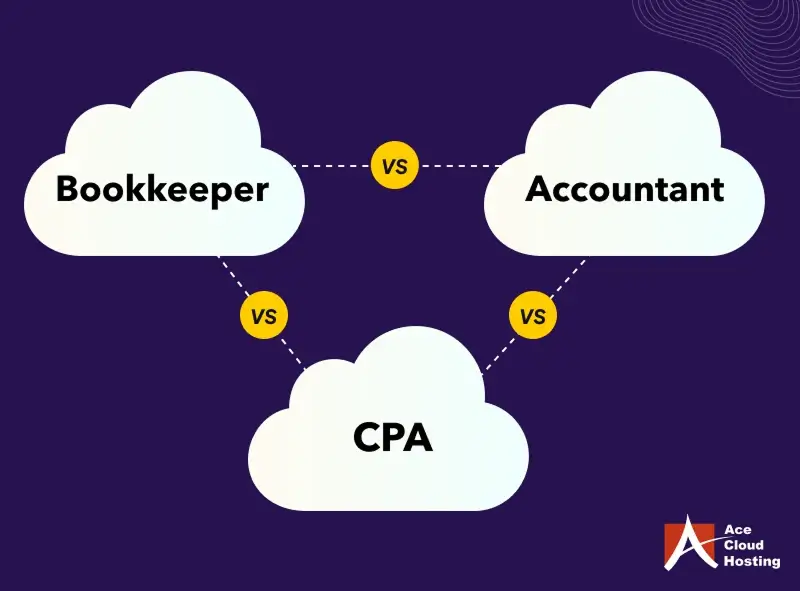
This guide breaks down the differences between bookkeepers, accountants, and Certified Public Accountants (CPAs). By the end, you’ll know exactly what each role does, how they differ in education and responsibilities, and when your business should hire them.
Who is a Bookkeeper?
A bookkeeper is the foundation of a business’s financial system. They are responsible for recording the day-to-day financial activities and ensuring the numbers are up-to-date and organized.
Most bookkeepers don’t need a formal degree; a high school diploma is often enough, though many pursue certifications in bookkeeping or popular accounting software such as QuickBooks, Xero, or FreshBooks. What matters most are the skills they bring: strong attention to detail, good with numbers and spreadsheets, proficiency with accounting tools, and the ability to stay consistent and organized.
Hiring a bookkeeper makes sense if you’re a startup or small business that needs accurate financial records, someone to handle payroll and invoices regularly, or simply want to free up time from routine financial tasks so you can focus on growing your business.
Core Tasks of a Bookkeeper
- Recording sales, expenses, and payments in accounting software.
- Handling accounts payable (money going out) and accounts receivable (money coming in).
- Processing payroll for employees.
- Reconciling bank and credit card statements to match records with actual transactions.
- Generate simple reports to show cash flow and outstanding balances.
Who is an Accountant?
An accountant builds on what bookkeepers do. While bookkeepers focus on recording, accountants interpret the financial data and provide insights. They ensure compliance with tax laws, prepare financial statements, and assist businesses in making informed financial decisions.
Most accountants hold at least a bachelor’s degree in accounting, finance, or business. Many enhance their expertise with professional certifications such as CMA (Certified Management Accountant) or ACCA (Association of Chartered Certified Accountants). In the US, accountants who specialize in tax may also become an Enrolled Agent (EA), a federal credential issued by the IRS that allows them to represent taxpayers before the IRS.
Essential accountant skills include a strong understanding of accounting principles like GAAP or IFRS, analytical and problem-solving abilities, tax knowledge, and the communication skills to explain complex financials in simple terms.
Hiring an accountant is a smart decision when your business is growing, financial transactions are becoming more complex, or you need expert support with tax planning and filing. Accountants also provide financial analysis and insights that help guide strategic decisions, making them valuable partners for sustainable business growth.
Core Tasks of an Accountant
- Preparing financial statements like balance sheets, income statements, and cash flow reports.
- Managing tax planning and filing tax returns.
- Helping businesses budget, forecast, and manage cash flow.
- Providing advice on financial health, growth, and profitability.
- Assisting in audit preparation.
Suggested Read: Top 25 Women in Accounting To Follow
Who is a CPA?
A CPA (Certified Public Accountant) is an accountant who has met additional education, experience, and licensing requirements. CPAs hold the highest level of authority and credibility in the financial world.
Becoming a Certified Public Accountant (CPA) requires more advanced qualifications than a bookkeeper or accountant. A CPA typically holds a bachelor’s degree with at least 150 credit hours, though this is changing. Following 2025 updates to the Uniform Accountancy Act by the AICPA and NASBA, many states now also offer an alternative pathway: a bachelor’s degree (120 credit hours) plus two years of professional experience, as an option alongside the traditional 150-hour route. Exact requirements are set by each state Board of Accountancy and vary by state.
A CPA candidate must also pass the CPA Exam and gain supervised work experience under a licensed CPA. Since January 2024, the CPA Exam follows a “Core-Plus-Discipline” model under the CPA Evolution initiative: three required Core sections are Auditing and Attestation (AUD), Financial Accounting and Reporting (FAR), and Taxation and Regulation (REG) plus one Discipline section the candidate chooses from Business Analysis and Reporting (BAR), Information Systems and Controls (ISC), or Tax Compliance and Planning (TCP). To maintain their license, CPAs must also complete ongoing continuing education.
Key CPA skills include advanced accounting knowledge, strong analytical and auditing expertise, leadership ability, and a deep understanding of ethics and compliance. You should hire a CPA when your business requires audited financial statements, investor or lender verification, complex tax strategies, or representation in front of tax authorities. CPAs also act as authoritative advisors for regulatory compliance, making them essential for larger businesses or those facing high-level financial challenges.
Core Tasks of a CPA
- Conducting audits and assurance services to verify financial statements.
- Representing clients before the IRS or other tax authorities.
- Handling complex tax planning for corporations, partnerships, and individuals.
- Providing consulting on mergers, acquisitions, and advanced financial strategies.
- Offering expert opinions that investors, lenders, and regulators trust.
Suggested Read: 15 Directories to Find CPAs and Accountants Near You for Your Business
Comparing Tasks Across Bookkeepers, Accountants, and CPAs
To see the differences more clearly, let’s take a few common financial tasks and compare how bookkeepers, accountants, and CPAs handle them.
1. Recording Transactions
Bookkeepers are the ones who directly handle transaction entry. They record every sale, expense, bill, and payment in accounting software to ensure nothing is missed. Their work provides the raw financial data that keeps the books accurate.
Accountants, on the other hand, rarely spend time entering transactions. Instead, they review the work of bookkeepers, checking whether entries are correctly categorized and matched to business activities. CPAs don’t generally deal with transaction-level data at all. They rely on the accuracy of the bookkeeping and accounting records when performing audits or offering professional opinions.
2. Preparing Financial Reports
When it comes to financial reports, the bookkeeper’s role is more basic. They can pull together internal summaries like cash flow reports, lists of unpaid invoices, or payroll records. These are useful for day-to-day decision-making. Accountants prepare full sets of financial statements such as the balance sheet, income statement, and statement of cash flows.
They go further by interpreting what these reports mean for the health and direction of the business. CPAs take it one step higher by providing audited or certified financial reports. These carry legal and professional weight and are trusted by investors, lenders, and regulatory bodies.
3. Tax-Related Work
Bookkeepers usually don’t prepare taxes, but they make tax time easier by organizing receipts, tracking deductible expenses, and maintaining a clean record of income and costs. Accountants play a central role in tax filing. They prepare returns, calculate liabilities, and guide businesses on tax-saving strategies while ensuring compliance with the law.
CPAs can do all this but also handle high-stakes scenarios such as representing clients before the IRS or state tax authorities. They are especially valuable when a business is audited or has complex tax needs, like multi-state operations or corporate restructuring.
4. Advisory and Planning
Bookkeepers provide little advisory input beyond pointing out irregularities, such as late payments or unusual cash flow patterns. Accountants, however, step into the role of advisors by offering insights on cost control, budgeting, profitability, and overall financial health.
Their advice helps business owners plan for sustainable growth. CPAs bring advisory services to an even more strategic level. They guide on matters such as mergers, acquisitions, succession planning, or investment strategies, and their recommendations carry extra credibility due to their licensing and professional standards.
5. Auditing and Compliance
Bookkeepers don’t conduct audits but are responsible for keeping records in order so that audits, if required, are easier to manage. Accountants often help prepare for audits by checking that financial statements are accurate, reconciliations are completed, and records meet compliance standards.
CPAs are the only ones authorized to perform actual audits and issue official audit opinions. Their assurance services confirm that financial statements are accurate and reliable, giving confidence to regulators, banks, and investors.
6. Cost of Services
Cost is another area where these roles differ. Bookkeepers usually charge the least, as their work is task-focused and administrative. Accountants cost more because their expertise goes beyond recording and involves analysis, compliance, and reporting.
CPAs command the highest fees because they bring advanced qualifications, licensing, and the ability to handle complex, high-stakes financial responsibilities such as audits and tax disputes.
Recommended Reading: 12 Places to Find CPAs and Accountants for Your Business
Key Differences: Bookkeeper vs. Accountant vs. CPA
| Criteria | Bookkeeper | Accountant | CPA |
| Main Role | Records daily transactions | Analyzes and interprets financial data | Licensed professional for audits, advanced tax, and assurance |
| Certification | Optional (bookkeeping certs) | Optional (CMA, ACCA, etc.) | Mandatory CPA license |
| Scope | Data entry, payroll, reconciliation | Financial statements, tax filing, and analysis | Audits, assurance, representation, and advanced tax |
| Cost Level | Lowest | Moderate | Highest |
How AI and Cloud Technology Bring Bookkeepers, Accountants, and CPAs Together
One of the biggest shifts affecting bookkeepers, accountants, and CPAs today is automation. Understanding where the profession is heading can help you decide not just who to hire, but what to expect from them in the years ahead.
The roles are diverging. According to the US Bureau of Labor Statistics, employment of accountants and auditors is projected to grow about 5% from 2024 to 2034, faster than the average for all occupations, while employment of bookkeeping, accounting, and auditing clerks is projected to decline by roughly 5% over the same period. Routine, rules-based tasks such as data entry and simple reconciliation are increasingly automated, while work that requires professional judgment and advisory insight is growing in demand.
Modern accounting tools are what make this shift possible. Platforms like QuickBooks Enterprise, Sage, and others streamline everything from daily transaction entry to financial reporting and audits, and each role benefits differently. For bookkeepers, these tools simplify routine work such as recording expenses, processing payroll, and reconciling bank statements, so they spend less time on manual entry and more time ensuring records are accurate.
Accountants use the same platforms to prepare financial statements, analyze cash flow, and manage taxes; because the data is already clean and organized, they can focus on interpreting numbers instead of fixing errors. CPAs benefit too, especially when handling audits or compliance, where reliable, up-to-date records give them the foundation to provide accurate opinions and strategic advice.
The real advantage is when you host these applications in the cloud. Hosting QuickBooks or Sage in the cloud brings bookkeepers, accountants, and CPAs onto the same platform, allowing real-time collaboration from anywhere. A bookkeeper can update invoices, an accountant can review financial reports, and a CPA can check compliance, all simultaneously working on the same data. This removes delays, reduces errors, and keeps everyone aligned.
The takeaway for business owners is practical: modern bookkeepers spend less time on manual entry and more time ensuring accuracy, while accountants and CPAs are increasingly valued for advisory work that software cannot replicate: professional judgment, ethical reasoning, and accountability.
When choosing a financial professional, look for one who uses these tools well rather than one who competes with them. Businesses can adopt cloud-hosted solutions from a reliable company like Ace Cloud Hosting to create a connected financial ecosystem where every role bookkeeper, accountant, and CPA can contribute more effectively to growth and compliance.
Which Accounting Professional Should You Choose to Simplify Financial Tasks?
Bookkeepers, accountants, and CPAs each bring their own strengths to the table. Bookkeepers keep your daily records clean and organized, accountants turn those numbers into reports and insights you can act on, and CPAs step in with licensed authority for audits, complex taxes, and long-term tax planning.
So, who should you choose? It depends on where your business is right now. A bookkeeper is your go-to if you need help with everyday financial tasks. An accountant adds real value if you’re growing and want guidance on taxes and compliance. And when your business faces audits, investor requirements, or complex financial decisions, a CPA is the expert you’ll need.
By matching the right professional to the right stage, you’ll build a financial foundation that supports your business today and prepares it for long-term success.
The Evolving Role of Bookkeepers, Accountants, and CPAs
The role of a Certified Public Accountant (CPA), Bookkeepers, and Accountants is evolving far beyond routine compliance and accounting work. Businesses are no longer satisfied with professionals who only record transactions or prepare tax returns; they want advisors who can guide strategy and growth.
Businesses are increasingly evaluating their financial professionals not just on their ability to record past transactions, but on how effectively they can provide insights for the future. This shift is evident in recent industry data. According to Xero’s 2025 US State of the Industry Report, the percentage of practices offering client advisory services such as forecasting, budgeting, and financial strategy has risen significantly, from 41% in 2023 to 85% in 2025. The report also highlights that clients now expect more proactive strategic insights and business advice, which firms identify as one of their top ongoing challenges.
What truly separates a standard CPA, bookkeeper, and accountant from a trusted advisor is the combination of technical expertise and advisory insight. Mastery of accounting principles alone isn’t enough; today’s most valued accounting professionals are those who pair deep financial knowledge with the ability to anticipate challenges, recommend solutions, and influence better business decisions. This evolution is turning bookkeepers, accountants, and CPAs into indispensable partners in driving long-term success.