Table of contents Toc Icon
Table of contents Toc Icon
Client Advisory Services has moved far beyond periodic reporting. Today, firms are expected to deliver timely insight, stronger financial visibility, and advice that helps clients make better decisions throughout the year. But that kind of value does not come from good intentions alone. It depends on workflows, clear policies, and technology that actually support how the work should move.

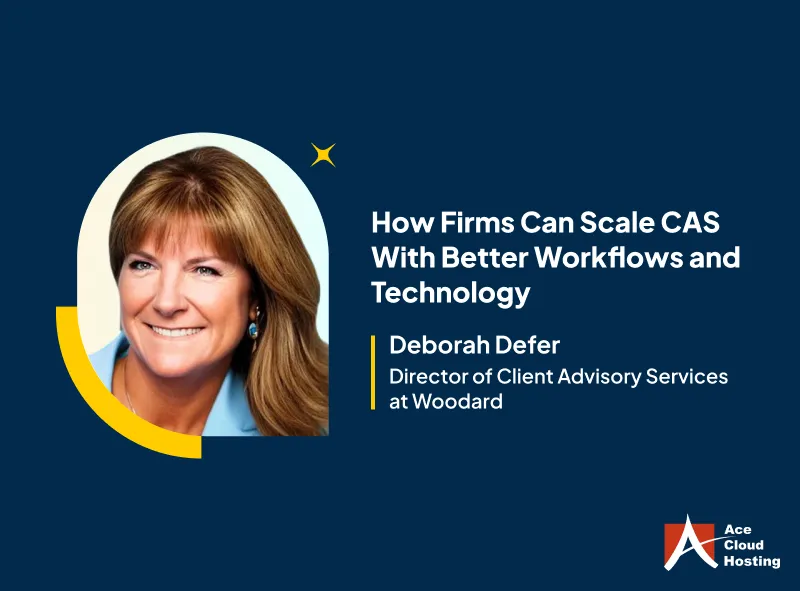
To explore what it takes to build CAS operations that scale, Ace Cloud Hosting spoke with Deborah Defer, Director of Client Advisory Services at Woodard and one of Accounting Today’s Top 100 People to Watch in 2026. With more than three decades of experience in accounting, financial management, and strategic advisory, Deborah has helped firms strengthen delivery, improve operational efficiency, and build more forward-looking advisory models.
In this conversation, she explains why documentation must focus on outcomes, how firms should think about technology in relation to process, and why structured workflows are essential for scaling CAS, improving spend management, and moving from compliance work to true advisory value.
How can firms document their CAS workflows in a way that improves onboarding, accountability, and consistency across the team?
Firms often make mistakes by documenting tasks rather than outcomes. Strong CAS workflows start with clearly defining the “why” behind each process, what result are we driving for the client?
From there, documentation should follow a layered approach: high-level workflow maps for visibility, detailed SOPs for execution, and embedded checklists that the tool’s teams use daily.
The key is accessibility and usability. If documentation lives in a static manual that no one opens, it fails. Instead, firms should integrate workflows into their practice management systems, so guidance appears in the moment of work. This dramatically improves onboarding, as new team members can learn by following the procedures rather than searching.
Accountability comes from clarity and clearly defined roles, handoffs, and expected timelines. Consistency follows when every client engagement is anchored in a standardized framework, with room for customization where needed. Ultimately, documentation should not feel like bureaucracy; instead, it should feel like enablement.
What role should technology play in supporting CAS workflows, and how can firms make sure their tech stack reinforces good processes instead of adding more complexity?
Technology should amplify a well-designed process, not compensate for a broken one. Too often, firms layer tools on top of unclear workflows, creating complexity rather than efficiency.
The right approach is process-first, technology-second. Define your ideal workflow, identify friction points, and then select technology that supports automation, visibility, and scalability within that structure. Every tool in the stack should have a clear purpose tied to a specific step in the workflow, if it doesn’t, it’s likely adding noise.
Integration is critical. Disconnected systems create duplicate work, data inconsistencies, and frustration. Firms should prioritize a cohesive ecosystem that enables seamless data flow, reducing manual intervention and increasing confidence in reporting. Building palaces and not Frankenstein’s!
Finally, simplicity wins. A smaller, well-integrated stack that aligns with your processes will outperform a large, fragmented one every time. The goal isn’t more tech—it’s better orchestration of work.
Is the real barrier to scaling CAS not technology, but the lack of clearly defined policies, processes, and procedures, and how should firms structure these to move from compliance to advisory?
Absolutely. Technology is rarely the limiting factor; lack of structure is. The 3 Ps are critical; without clearly defined policies, processes, and procedures, firms remain stuck in reactive, compliance-driven work because there’s no foundation to support proactive advisory.
Policies set the standards and hold people accountable; how we price, how we communicate, what services we deliver. Processes define the flow of work, what needs to be done, and how data moves from intake to insight. Procedures outline the execution, with step-by-step consistency across the team.
To move into advisory, firms must intentionally design workflows that go beyond “closing the books.” This means embedding analysis, review checkpoints, and client-facing insights into the process itself. Advisory shouldn’t be an add-on—it should be built into the workflow.
Scaling CAS requires operational maturity. When policies, processes, and procedures are aligned, firms gain the capacity to deliver consistent, high-value insights at scale without relying on individual heroics.
Spend management is becoming a bigger responsibility within CAS. How can structured workflows help firms track and control client expenses more effectively?
Spend management is one of the most tangible ways CAS teams can drive value, but it requires intentional workflow design. Without structure, firms are simply recording expenses rather than influencing them.
A strong workflow begins with standardized categorization and real-time data capture, ensuring expenses are consistently coded and visible. From there, firms should build in review checkpoints, monthly or even weekly, to identify anomalies, trends, and opportunities for cost control.
The real shift happens when workflows incorporate proactive triggers. For example, alerts for budget variances, duplicate spend, or unusual vendor activity enable firms to move from hindsight to foresight.
Equally important is establishing policies with clients and clear guidelines on approvals, spending thresholds, and vendor management. When workflows and policies align, firms are no longer just tracking spend; they’re helping clients control it. And generating wealth for a client.
This is where CAS moves from transactional (formerly called bookkeeping) to advisory: turning data into actionable insights that directly impact profitability.
From Workflow Discipline to Advisory Value
Deborah’s perspective makes one thing clear. CAS does not scale because a firm buys more tools. It scales when policies, processes, and procedures are aligned around the client’s desired outcome.
That structure changes everything. Onboarding improves because new team members can follow clear paths. Accountability improves because roles, handoffs, and timelines are visible. Advisory improves because analysis and insight are built into the workflow rather than added at the end.
The same principle applies to spend management. When workflows include clear categorization, review checkpoints, and proactive alerts, firms do more than record expenses. They help clients control spending, spot risks earlier, and protect profitability.
The firms that lead in CAS will be those that design intentionally. Clear workflows, well-chosen technology, and strong operational discipline create the consistency needed to deliver higher-value guidance at scale.
At Ace Cloud Hosting, we partner with accounting and CPA firms to power their CAS practices with secure, scalable cloud solutions. From hosting desktop products like QuickBooks to delivering managed security and managed IT services, we help firms streamline operations, automate routine workflows, and focus more on high-value advisory.