Table of contents Toc Icon
Table of contents Toc Icon
Every SOLIDWORKS user runs into the same problem eventually. An assembly that used to open in a few seconds now takes minutes. A simulation that used to finish overnight now takes two days. And the laptop that functioned perfectly a year ago suddenly can’t keep up with today’s demands.
The usual fix is to buy a bigger, more expensive computer. But that’s slow, costly, and outdated again within a year or two. Hosted SOLIDWORKS cloud solutions take a different approach: instead of upgrading the computer under someone’s desk, they run SOLIDWORKS on powerful servers in a data center and simply stream the screen back to whatever device the person is using.
Let’s explore how cloud solutions address two of the toughest tasks in SOLIDWORKS: large assemblies and simulations.
Why Big Assemblies and Simulations Slow Your Computer Down
SOLIDWORKS’s own system requirements call for at least 16 GB of memory (32 GB recommended) and a graphics card with an officially certified driver, and that’s just for general use, not heavy assemblies. As a model grows, three things happen at once:
- The processor becomes a bottleneck. Most of the processes in SOLIDWORKS, such as rebuilding a model or navigating the feature tree, are executed on a single processor core at a time. Therefore, the speed of an individual core is more crucial than having multiple cores.
- The graphics card has to redraw everything. Every time you rotate, zoom, or shade a large assembly, that’s real-time graphics work. A regular gaming graphics card can run SOLIDWORKS, but it isn’t checked against SOLIDWORKS’s official list of tested cards and drivers, which is often why people see flickering, glitchy shading, or crashes.
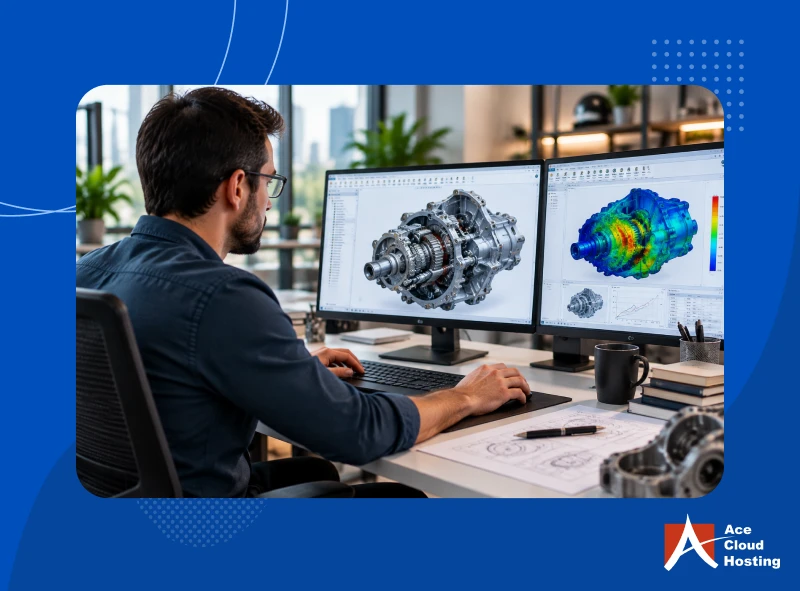
- Simulation needs a completely different setup. SOLIDWORKS Simulation studies, such as stress, heat, or vibration analysis, rely more on memory and processing power than everyday modeling. Simulation benefits from a high-clock-speed processor with more cores, at least 32 GB of memory (64 GB or more for large studies), fast solid-state storage, and a certified graphics card for reviewing results. More cores don’t always mean a proportionally faster result. Some parts of a simulation calculation can’t be split across multiple cores no matter how many you add, which is exactly why simply buying a bigger machine doesn’t always pay off.
In practice, that means the workstation spec needed for a team’s heaviest work is far higher than what most engineers need day to day. Buying that spec for everyone is expensive, and buying it for only a few people creates bottlenecks.
What Does “SOLIDWORKS in the Cloud” Actually Mean?
It’s important to distinguish between two concepts that people often confuse when discussing “SOLIDWORKS in the cloud.”
The first is a hosted virtual desktop. This setup provides a complete, familiar copy of SOLIDWORKS (using your existing license) that runs on a powerful computer located in a data center. You can access this virtual desktop from a laptop, thin client, or Mac.
The second is Dassault Systèmes’ own 3DEXPERIENCE Works Simulation, which lets you send a specific, very heavy simulation job to Dassault’s own cloud computers while you keep modeling on your regular machine. Dassault describes this as a way to free up your own computer while a study runs in the background, so results are ready when you check back, and it lets you run several simulation scenarios at the same time instead of one after another.
These two things aren’t competing with each other; they solve different problems. A hosted cloud desktop for SOLIDWORKS gives every engineer consistently strong performance for everyday modeling, big assemblies, file management, and routine simulation. Dassault Systèmes’ cloud simulation tools can provide extra computing power for occasional large or complex studies that exceed the practical limits of a local or virtual workstation.
How the Cloud Handles Large Assemblies
1. The graphics work happens on a data center GPU, not your laptop
On a hosted SOLIDWORKS desktop, your model isn’t drawn by your laptop at all. It’s drawn by an NVIDIA GPU in the data center, allocated to your desktop through NVIDIA vGPU, and only the finished image is streamed to your screen.
Citrix HDX 3D Pro handles this delivery. It renders SOLIDWORKS’s OpenGL graphics on the server’s GPU and streams compressed frames to your device. That’s why a thin client or a basic laptop can rotate a heavy assembly smoothly. Network latency between the user and the data center matters more than raw bandwidth. See what actually works to run SOLIDWORKS remotely.
2. Memory and processing power grow with your project
Local computers are bought once, based on a guess about future needs. A cloud desktop can simply be given more memory, more processing power, or a stronger graphics card as a project assembly gets more complex, with no new hardware to order or install. Ace Cloud Hosting lets teams increase these resources as projects grow and offers a range of graphics card options sized to different workloads on its SOLIDWORKS hosting service.
3. Fast storage keeps files opening and saving quickly
Large assemblies that consist of thousands of interconnected parts can strain storage systems each time you open or save them. Hosted environments use fast solid-state drives by default, which is also what SOLIDWORKS recommends for local machines. This approach eliminates one more common factor that contributes to slow file opening times.
4. One shared, up-to-date set of files
A common issue with “assembly is slow” complaints is often related to confusion about which version is being referenced. This occurs when engineers are working from local copies, using outdated files, or experiencing slow file transfers over a company’s VPN. Running SOLIDWORKS PDM alongside SOLIDWORKS in the same cloud setup keeps every file centralized, so the assembly always pulls out the current, correct parts instead of an old local copy.
5. SOLIDWORKS’s built-in large assembly tools work as intended
None of this replaces the tools already provided by SOLIDWORKS; it simply enables them to function more effectively. Large Assembly Settings (called Large Assembly Mode before SOLIDWORKS 2020) is a set of built-in options, such as suspending automatic rebuilds and hiding sketches and reference geometry. It can switch on automatically once an assembly passes a component threshold you set. For very large assemblies, Large Design Review lets you open, navigate, measure, and section a model without fully loading it
On weak local hardware, these settings only partly make up for a lack of memory or graphics power. On a properly sized cloud desktop, they actually work the way they’re supposed to.
Run SOLIDWORKS on a cloud desktop built for complex assemblies and heavy file libraries.
How the Cloud Handles Simulation Workloads
SOLIDWORKS Simulation solves on the CPU and in memory, not the GPU. So, the cloud advantage here is about the right-sizing compute and memory for the study, with the GPU helping when you review results.
1. Processing power matched to the calculation
Since simulation studies do benefit from extra processor cores (up to a point), a cloud desktop can be set up with more high-clock-speed cores for simulation work, without forcing every other designer in the company onto that same expensive computer just so one person can occasionally run a study.
2. Memory that grows with the size of the study
Detailed simulations with fine meshes need a lot more memory than everyday part and drawing work. Instead of buying every engineer a computer with 64 GB of memory “just in case,” memory can be increased for users or project phases that need it, and adjusted again when the heavy work is done.
3. Smooth, real-time results review
Examining stress plots, heat maps, and deformation animations is a task that requires strong graphics capabilities. A GPU-powered virtual desktop can help keep navigation and result review responsive, even when working with large, detailed simulation outputs. The same acceleration that ensures assembly responsiveness also allows for seamless interaction with simulation results.
4. Extra power where it’s needed, with an option to offload the biggest jobs
Instead of every engineer owning a simulation-grade workstation that sits idle most of the month, higher-spec cloud desktops can be assigned to the people and projects that need them. For the rare study that exceeds even a well-sized desktop, Dassault’s 3DEXPERIENCE Works Simulation can send the solve to Dassault’s cloud and free up your machine. Dassault notes that long solve times often limit how often teams can run simulations. The two approaches work together: hosted desktops for day-to-day modeling and routine studies, and cloud solving for the occasional extreme job.
5. Predictable solve times across the team
When simulations are conducted on a standard cloud setup rather than on a personal computer owned by individual engineers, the solve times become consistent for the entire team. This means that a “quick check” study won’t unexpectedly take six hours just because it was run on someone’s four-year-old laptop.
What Actually Happened When Manufacturers Moved to the Cloud?
Ace Cloud Hosting’s case study highlights the experience of a U.S. manufacturer that faced challenges with heavy assemblies and simulation tasks that overwhelmed their local computers. Meanwhile, their remote design team in India struggled to maintain productivity due to a slow VPN connection.
After transitioning to a GPU-powered Cloud VDI, the company was able to expand its team to 37 engineers, each equipped with their own graphics-card-backed desktop and access to centrally stored SOLIDWORKS and PDM files.
The results were impressive: they achieved approximately 40% faster assembly opening times, had desktops ready for use within about an hour of setup, and managed to grow the team fourfold without the need to purchase any new workstations.
The key takeaway is that scaling the team became a challenge that no longer depended on hardware purchases.
Security, Teamwork, and Lower Costs
Moving SOLIDWORKS to the cloud isn’t just about speed. It changes a few other things too:
- Security: design files no longer live scattered across individual laptops. Hosted setups typically add extra login checks, encryption, firewalls, and protection against screen-recording or keystroke-logging software, which matters a lot for companies working under confidentiality agreements.
- Teamwork: spread-out teams (common in manufacturing, where design and factory locations are rarely in the same city) work off the same shared files instead of emailing large design files back and forth.
- Cost: a big upfront hardware purchase turns into a predictable monthly cost, and resources can be adjusted as projects change, instead of buying hardware for a peak that might only happen twice a year.
Run SOLIDWORKS Simulation on GPU-powered Cloud VDI with scalable cores and memory, and smooth results review.
What to Check Before You Move SOLIDWORKS to the Cloud
Hosted SOLIDWORKS removes the hardware bottleneck, but a few practical factors decide how smooth the experience feels:
Latency to the data center: The closer users are to the hosting region, the more responsive rotation and sketching feel. Test from every office location, including remote teams.
Licensing: You can usually bring your existing SOLIDWORKS license, whether single-user or network. Confirm with your provider how activation or the license server will be set up in the hosted environment.
Peripherals: Check that 3D mice, multiple monitors, and high-resolution displays work over the virtual desktop connection.
PDM and file location: Keep the PDM vault in the same environment as the desktops so large assemblies never load over a slow link.
Add-ins and integrations: List every add-in, macro, and connected tool (ERP, PLM) and include them in the trial.
How to Pick the Right Cloud Partner for SOLIDWORKS
If you’re comparing providers, a few things separate a setup that’s genuinely built for CAD from one that’s just a repurposed office computer in the cloud:
- Certified NVIDIA GPUs with right-sized vGPU profiles — matched to your assembly sizes, not an oversubscribed card shared by too many users.
- Support for everything you actually use — Simulation, PDM, Visualize, CAMWorks, and any other add-ons, not just basic SOLIDWORKS.
- The ability to scale up and down — more power for a busy simulation week, less the rest of the time.
- A solid uptime guarantee and regular backups — so your work is never at risk.
- The ability to use your existing SOLIDWORKS license — instead of being forced to buy a new one.
- Proper security certifications and controls — such as SOC 2 audited data centers, MFA, and encryption, especially if you work under client NDAs or in regulated industries
Test SOLIDWORKS With the Work You Actually Do
Large assemblies and simulation jobs can expose the limits of local hardware very quickly. Hosted SOLIDWORKS cloud solutions address this by moving the heavy computing work away from the user’s local machine.
Still, the right setup depends on what your team actually works on. Before choosing a provider, test your largest assemblies, common simulation studies, plugins, and PDM workflow in the environment.
That practical test will help you see whether the setup can handle your team’s everyday work, heavier projects, and future needs before you make the switch.