Table of contents Toc Icon
Table of contents Toc Icon
For many firms, tax planning still begins and ends with filing season. Returns are prepared, elections are reviewed, and projections are updated when time allows.
But as complexity grows, planning stops being a compliance function and becomes a systems challenge. When data is fragmented, documentation is inconsistent, and projections rely on incomplete inputs; strategy suffers.

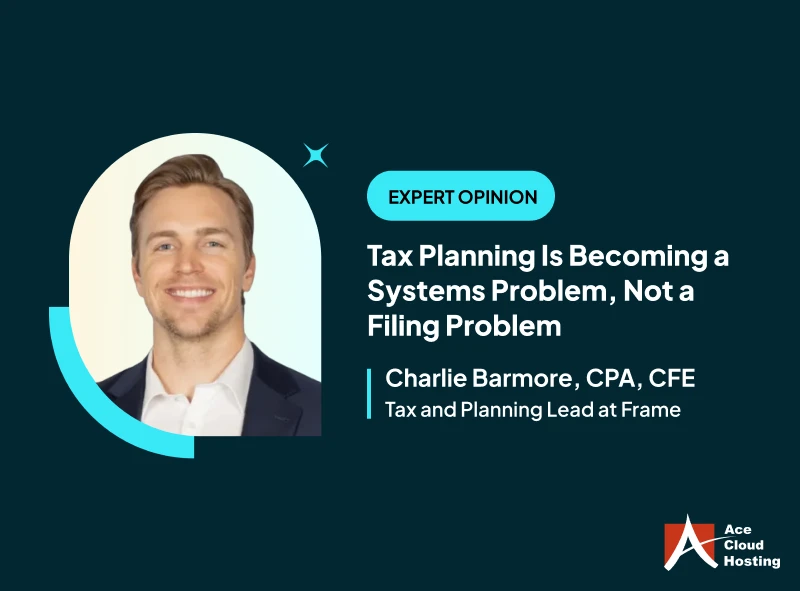
To explore how firms can move from reactive filing to proactive, multi-year tax planning, Ace Cloud Hosting spoke with Charlie Barmore, CPA, CFE, Tax and Planning Lead at Frame.
With nearly a decade in public accounting and deep expertise in equity compensation, advanced planning, and AI-enabled workflows, Charlie focuses on one central problem: closing the gap between what a great tax strategy looks like and who gets access to it.
In this conversation, he breaks down why documentation failures undermine strategy, how disconnected tools limit multi-year planning, and why AI only works when clean data, standardized workflows, and structured review systems come first.
Q1. When does tax planning stop being a “filing” issue and become a systems issue, and what are the first warning signs you look for?
I think tax planning has always had a systems component, but it’s just more visible now. Filing is reactive by nature: you’re working with what already happened. Planning is the opposite.
To do it well, you need systems in place that surface the right information at the right time, so you can actually make decisions before year-end, not after. The first warning sign that planning has become a systems issue is when you’re scrambling for data instead of analyzing it.
The warning signs are straightforward: clients repeatedly missing entity-level elections (S-corp reasonable comp, grouping elections) because data isn’t being captured on an ongoing basis.
Advisors are scrambling for historical docs for every engagement. An inability to quickly run “what-if” scenarios for major life events like selling a business, retirement, or inheritance. When you see those patterns, the system isn’t a feeding strategy; it’s more just storing last year’s return and information.
Suggested Read: AI Is Not the Problem. Bad Workflows Are: What Actually Breaks When Firms Try to Use AI
Q2. In your experience, which everyday workflow gaps make it hardest for firms to do multi-year and scenario-based tax planning consistently?
The biggest gap is that most firms are planning an incomplete picture and don’t realize it. They’re using 10 to 20 different tools, and none of them talk to each other particularly well. You need full context to do proper multi-year, scenario-based tax planning. Even if you’re missing one critical data point, the entire projection can be off, and you might not even know it.
This is where I think AI will have a massive impact as inference capabilities and context windows continue to scale. The ability to synthesize information across disconnected sources, flag what’s missing, and model scenarios against a client’s full financial picture, and not just one year’s return, is going to fundamentally change how firms approach multi-year planning. That’s a big part of what we’re building at Frame.
Q3. You’ve said documentation failures cause more missed deductions than “bad strategy.” What system habits help clients capture the right info all year?
This goes back to Q2: context is everything in our profession. You need all the information in order to provide a sound, accurate, and valuable strategy to clients. And it goes both ways. Clients don’t fully understand all the documentation we need. And if we’re not super familiar with the client yet, we may not know all the documentation we need either. It’s a real issue in our industry.
Not having all the information is the easiest way for things to slip through the cracks. Deductions and strategy get missed, or worse, you’re building someone’s plan on incomplete information.
The fix is a combination of better client education (simple templates, short videos on what actually matters, like substantiation rules), standardized intake processes, and firm-side workflows that flag missing docs early rather than at filing time.
Things like AI-powered expense tracking that OCRs receipts and tags them in real time help too, but the foundation is just making sure both sides know what’s needed and when.
Q4. As AI tools enter tax and planning, what goes wrong when firms automate before standardizing data, workflows, and review?
This is one I think about every day because I’m living it as I work on building AI-driven tax and planning workflows at Frame. The short answer: when firms automate before standardizing, they deliver wrong advice fast. And that erodes client trust faster than delivering no advice at all.
These AI tools are genuinely powerful. LLMs, coding agents, and agentic workflows are transforming what’s possible when it comes to tax and financial planning. But they’re force multipliers, not replacements for judgment. A force multiplier applied to a broken process just produces broken output at scale.
The most common pitfalls I see: firms rushing to generate “instant” projections without validating underlying data, teams relying on black-box tools without understanding what’s driving the output, and practitioners pulling from fragmented data sources expecting coherent results. Every one of those is a standardization problem, not an AI problem.
The firms that win this transition will do the unglamorous work first, such as making sure they have clean data pipelines, consistent document intake, and standardized review frameworks. You really need to nail those before layering AI on top for speed and pattern detection, and always have expert review before anything reaches a client.
Q5. For a firm that wants to deliver higher-end planning at scale, what must be true about their tech stack and process design before they add more clients or staff?
Before you scale, your tools have to integrate cleanly. That barrier is getting lower every day as platforms expand their scope and become near one-stop shops. But the fundamentals still matter.
A few things need to be true before you add clients or staff. You need a centralized client data hub, so no one is hunting through emails and shared drives. You need scalable review and quality gates where AI can flag anomalies, but humans make the final call. You need capacity modeling so you understand your bottlenecks before you hire. And you need client education systems so clients can self-serve where appropriate.
Test those workflows under pressure before you scale. Otherwise, you’re just multiplying inefficiency. The whole point of good systems is to create leverage and let your advisors spend their time on strategy and judgment, not admin work.
Must Read: Scaling an Accounting Firm in 2026: Insights From Sharrin Fuller
From Filing Season to Planning Systems
Charlie’s perspective reframes the conversation. Tax planning does not break because the strategy is weak. It breaks when systems fail to surface the right information at the right time. When firms scramble for documents, miss elections, or cannot model multi-year scenarios quickly, the issue is not intelligence. It is the underlying infrastructure.
AI will accelerate tax planning, but only for firms that standardize first. Clean data pipelines, centralized client information, defined review checkpoints, and integrated tools are not optional. They are prerequisites. Automation layered on top of fragmented systems simply produces errors faster.
Firms that invest in infrastructure before scale create leverage. Advisors spend more time on judgment and insight, and less time chasing data. That shift enables high-level planning to move from boutique service to scalable capability.
At Ace Cloud Hosting, we see firms of all sizes embracing cloud technology and AI to free up time, elevate client conversations, and make smarter decisions. As workflows automate and real-time collaboration becomes the norm, accountants must evolve into technology-driven advisors.
Standardize workflows, centralize client data, and enable secure AI-powered collaboration with cloud hosting built for accounting firms.