Table of contents Toc Icon
Table of contents Toc Icon
The age-old accounting industry has evolved through several phases over decades. From paper-based accounting to the digital transition and the age of AI, accounting processes have constantly transformed to meet contemporary requirements.
The next phase in this evolution is zero-touch accounting that aims to reduce human intervention to a minimum by creating a technological ecosystem that can learn, predict, act, and evolve with the accounting process.
This shift is already becoming measurable. About 32.6% of invoices are now processed without human intervention, rising to 49.2% among best-in-class AP teams, as per Payables Place.
Let’s explore zero-touch accounting in detail.
What is Zero-touch Accounting?
Zero-touch accounting is an ecosystem of tools, technology, and workflows that work together to fully automate the accounting process. Instead of using standalone automation tools, a range of tools, APIs, technologies, and platforms are integrated to achieve total automation.
However, zero-touch accounting does not mean replacing accounting professionals. Instead, it aims to handle repetitive tasks and free up time for other core processes.
Run your accounting applications in a secure, scalable cloud environment.
Tools and Technologies Involved in Zero-touch Accounting
Here are some major tools and technologies you need to implement zero-touch accounting in your firm.
1. Artificial Intelligence (AI)
AI is key to implementing zero-touch accounting in your firm. AI-powered tools for processes, such as accounts payable and reconciliation, automate tasks while offering data-driven insights for informed decision-making. Moreover, technologies like agentic AI take a goal-based approach and utilize in-house tools to accomplish tasks without human intervention.
2. Machine Learning
Machine Learning (ML) algorithms introduce self-improvement in the accounting process. They use historical and real-time data to improve operational performance and adapt to changing business requirements. ML is critical for maintaining operational efficiency and ensuring accurate results.
3. Optical Character Recognition (OCR)
Optical Character Recognition extracts the required information from specific fields in invoices, bills, and purchase orders. It eliminates manual data entry, a leading cause of accounting errors. Moreover, it integrates with the accounting software to automatically sync data into financial records.
4. Robotic Process Automation (RPA)
RPA uses bots to perform internal accounting tasks without human intervention. You can use it to generate periodic reports, send reminders, and reconcile bank accounts.
5. Cloud Platforms
Cloud hosting platforms enable firms to create a comprehensive zero-touch accounting ecosystem on the cloud. Compared to a traditional in-house IT setup, cloud hosting offers additional benefits of remote access, scalability, and data security. Moreover, it reduces total cost of ownership and in-house IT complexity.
6. API Integrations
API integration is essential to integrate different tools in zero-touch accounting. It also connects in-house apps with external applications, bank feeds, emailing systems, SaaS tools, and more.
Zero-touch Accounting: Real-life Workflow
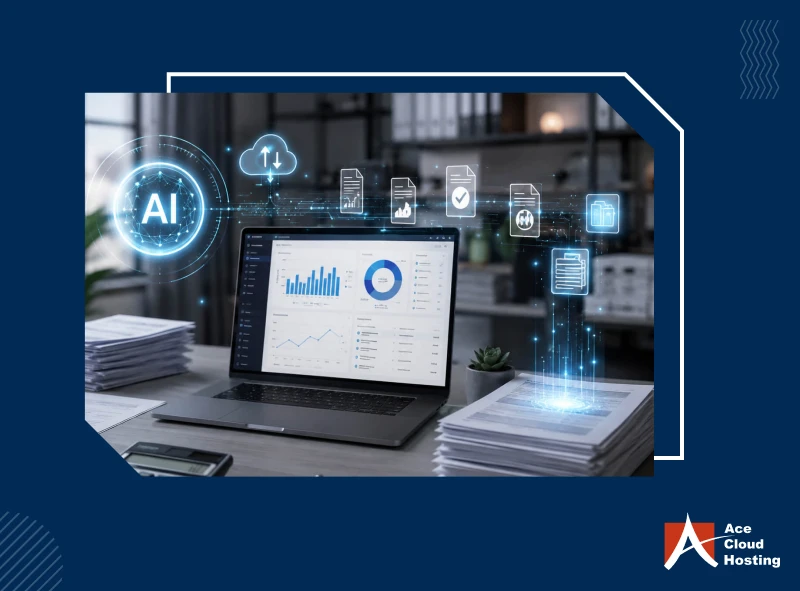
Imagine you are an accounting firm with a zero-touch accounting ecosystem. The client uploads documents, such as invoices and bills, in the client portal. Integrated OCR tools extract data from the documents and send it directly to the accounting software. Accounting software reviews the data, reconciles it, and sends notifications for flagged entries.
The AI-powered features in the accounting software generate periodic reports and send automated reminders to clients to e-sign a document or provide approvals. Customer information is automatically updated in the integrated CRM, and the integrated AR tools send payment reminders.
Benefits of Zero-touch Accounting for Businesses
Let’s discuss how creating a zero-touch accounting ecosystem can benefit your firm.
1. Time Management
Time management is essential for CPAs, especially in the hectic tax season. However, tasks such as data entry and reconciliation consume significant time. During tax season, it not only causes mental stress but also leads to errors they can’t afford.
Zero-touch accounting saves a CPA’s valuable time by automating these processes. As a result, they can close their books faster, work stress-free, and accommodate more clients.
2. Reduces Human Errors
Accountants are bound to make errors, especially in high-pressure situations like tax season. However, a small data entry error can cause issues in tax returns and reconciliations. Clients do not appreciate discrepancies in their financial records and may consider terminating services.
In zero-touch accounting, as different tools (accounting, invoicing) integrate to enable real-time data sync, the chance of human error is minimal. Moreover, advanced AI tools enable fraud detection and data checks that flag any discrepancies and notify the accountants.
3. Compliance Assurance
Given the number of data regulations CPA firms need to comply with compliances which can be challenging. Moreover, non-compliance can lead to heavy penalties and legal trouble.
Zero-touch accounting works on a workflow that helps ensure compliance. Reports are generated automatically and can be referenced during audits. Moreover, it reduces the risk of errors and anomalies that can trigger non-compliance. You can also set predefined rules and internal controls to prevent unauthorized access and maintain audit trails.
Related Article: Accounting Compliance: What You Need to Know
4. Enhances CPA Productivity
An accountant can handle only a limited number of clients in a time period. However, tasks such as maintaining books and matching invoices take much of their time.
Zero-touch accounting optimizes an accountant’s productivity by taking on most repetitive tasks and allowing them to focus on critical processes, such as financial forecasting and cash flow optimization. As a result, firms can offer advisory services to clients in addition to general accounting. Moreover, the time freed up by automation reduces mental stress, supports upskilling, and improves work-life balance.
5. Cost Savings
Traditional accounting involves accomplishing multiple tasks manually, which demands extensive human resources. Moreover, as the firm grows, you must scale the team accordingly, adding to overall operational costs.
Although zero-touch accounting requires an initial investment in software tools and IT infrastructure, it proves lucrative in the long run. Because most tasks are automated, firms can serve more clients with a smaller team.
Moreover, as the business grows, accounting tools can scale according to requirements. In addition, if you outsource zero-touch accounting to a provider, you don’t even need to make the initial capital investments to set up the IT infrastructure.
Zero-touch Accounting – What are the Best Practices?
If implemented efficiently, zero-touch accounting can help firms scale new heights in the long run. However, during the initial phases, firms must consider the following best practices.
1. Standardize Workflows
Before implementing accounting tools, you must plan predefined rules and workflows. Once tools are integrated and internal controls are set up, consistent workflows enable easier syncing and fewer issues.
2. Adapt in Phases
Zero-touch accounting implies automating the complete accounting process. However, to achieve it, you must not automate every process altogether. Start by automating a few low-priority tasks first. After analyzing the functioning for a period, continue with other tasks gradually.
3. Train the Team
Adopting zero-touch accounting depends heavily on how quickly and efficiently employees in your firm adapt to it. Inefficient adoption can lead to productivity loss, consistent delays, and a subpar client experience. Therefore, implement comprehensive training sessions that cover tool demos, workflow understanding, the escalation matrix, AI policies, and data security best practices. Moreover, take a proactive approach to training sessions instead of planning them after zero-touch accounting has been implemented. Keep training sessions interactive to reduce employee resistance to the new technology.
4. Focus on Data Security
When it comes to AI and automation, data security has always been a concern. Therefore, given the critical financial data dealt with, firms must ensure all security protocols, tools, and controls are integrated with the zero-touch accounting environment.
You must implement 24/7 IT monitoring with safeguards, such as 256-bit data encryption, multi-factor authentication, Identity & Access Management (IAM), OS upgrades, and automated backups. Moreover, you must create an internal AI policy and ensure every employee understands best practices.
Challenges of Zero-touch Accounting
Here are some challenges firms might encounter while implementing zero-touch accounting.
1. Integration Challenges
Zero-touch accounting comprises multiple tools and technologies that must integrate to create a seamless, automated workflow. Moreover, these tools are deployed on different platforms (one can be installed on an on-premises workstation while others can be SaaS-based). Integrating a large number of tools can lead to compatibility issues.
2. Change Management
Moving toward zero-touch accounting can significantly change how accountants perform day-to-day work. Even when automation delivers long-term benefits, employees may initially be hesitant to adopt new workflows, especially if roles, responsibilities, or familiar processes are changing.
3. Cybersecurity Concerns
Automated workflows always run the risk of cyberattacks because of minimal human intervention. Although automated, the security team must monitor systems 24/7 for any anomalies and red flags.
Move your accounting applications to a secure, managed cloud environment.
Zero-touch Accounting is the Future
As technologies like Agentic AI evolve, zero-touch accounting will become the norm. Firms that gain a first-mover advantage will be far ahead of competitors in reputation, service, and profitability. However, implementing it in-house can be challenging at first because it requires significant investment and technical expertise.
Ace Cloud Hosting helps CPA and accounting firms explore AI without exposing local devices or giving agents unrestricted access to sensitive client data. Automate workflows, process documents, summarize information, and work with hosted accounting applications inside an isolated, managed workspace.