Table of contents Toc Icon
Table of contents Toc Icon
Accounting firms are investing heavily in AI, automation, advisory services, and new technologies. Yet many transformation initiatives fail to deliver the expected results. The problem is rarely the technology alone. More often, firms struggle with unclear objectives, limited internal alignment, poor communication, and inadequate change management.

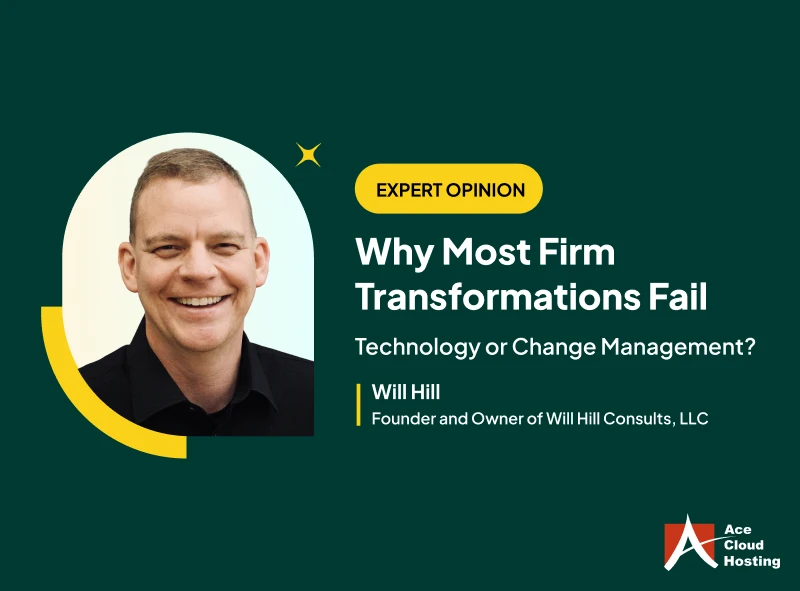
To explore why firm transformations often fail, Ace Cloud Hosting spoke with Will Hill, Founder and Owner of Will Hill Consults, LLC.
With more than 24 years in the accounting profession and experience working with 400+ accounting firms across the country, Will helps firm leaders improve operations, strengthen accountability, and build healthier systems at the intersection of people and process.
Recognized by Accounting Today as one of the Top 100 Most Influential People in Accounting and a two-time CPA Practice Advisor Under 40 honorees, Will brings a practical view of what makes change work inside real firms.
In this conversation, he explains why transformation must start with a clearly defined problem, how internal communication affects adoption, and why client impact should remain central to every operational improvement.
Q1. Many firms talk about advisory, AI, and transformation, but few successfully implement change. Where do firms usually get stuck?
Firms get stuck in change implementation often before it even starts – but they don’t realize it. Change for the sake of change and chasing what is new sounds obviously like the wrong strategy, but it is what is done time and time again. Firms can defeat this silent transformation killer by doing one simple thing:
Requiring all change to have a stated problem they are solving (whether that is fixing things that are happening or doing things that are not happening) and quantifying the impact internally and/or externally for that change.
This will help keep the goal in mind when selecting new tools/processes, as well as point the team towards a collective goal as they undertake the change.
Q2. Why is change management often harder for accounting firms than the technology adoption itself?
Accounting firms are excellent at things that are tangible and repeated. We see this in the everyday work of journal entries, tax returns, audits, etc. Where fewer firms excel are those things that bring in the intangible.
Effective change management touches many areas of human behavior and firm context, which are generally intangible and varied. Adjusting to this dynamic from the opposite normal daily dynamic requires focus and intentionality – and it can’t be billed!
This leads to fatigue, and returning to operating where they are more comfortable in the tangible and repeatable.
Q3. What role does internal communication and team buy-in play when firms try to improve workflows or client service models?
Internal communication plays a key role – but this is where much of the struggle is. To have good internal communication, there are 3 primary components to consider:
- Consistency – This has to happen before the project starts, as the project goes, and when the project is finished. All too often, firms communicate early, but then it fades away as the project moves on.
- Relevance – Communications need to be relevant. This means we may need to split the audience apart to give the proper level of detail (eg – Departments not affected: Broad; Departments impacted: Timelines and expectations; Stakeholders: timelines, hurdles, metric-based results)
- Mode – Are we communicating through email, meetings, chat, etc. – hitting the way people like to receive information? Are we also then pointing all communication back to the same repository/info site for the change, so that no matter how they consume the communication, all people are driving back to the same single source of truth?
Q4. You often emphasize understanding the client deeply. How can firms avoid becoming too process-focused while still improving operational efficiency?
The most critical part of process improvement is those areas that produce friction between the firm and the client. If we start there, this will help the firm stay balanced in its change perspective.
Additionally, whenever changes are internally focused, there is still a client impact (speed, accuracy, etc.) – and that needs to be framed in a manner that reminds the team members of the impact to the client.
If the firm can adopt their change approach and have it reflect the client components, then when any change goes through their approach, the client considerations will be incorporated.
Q5. If a firm wants to make one meaningful operational improvement this year, where should leadership focus first?
Leadership should have a list of problems that need to be tackled. Some of these may include opportunities they are not taking advantage of. From there, rank those problems to solve and attack that list.
Firms who have historically struggled with making changes work may wish to put a less impactful, but easier win first – to gain momentum. This list will allow better communication, more focused effort, and less time switching back and forth between initiatives.
Secure cloud infrastructure built to support smarter, scalable firm transformation.
Change Works When the Problem Is Clear
Will’s perspective makes one thing clear. Firm transformation does not fail because firms lack ideas. It fails when change begins without a clearly defined problem, measurable impact, or shared understanding of why the change matters.
Technology can support progress, but it cannot create alignment on its own. Firms need consistency in communication, relevance for each audience, and a single source of truth that keeps everyone connected as the project moves forward. Without that structure, teams lose momentum and return to familiar habits.
With secure cloud hosting, scalable infrastructure, and 24/7 support, Ace Cloud Hosting helps accounting firms modernize their operations while reducing the technical complexity that often slows transformation initiatives.