Table of contents Toc Icon
Table of contents Toc Icon

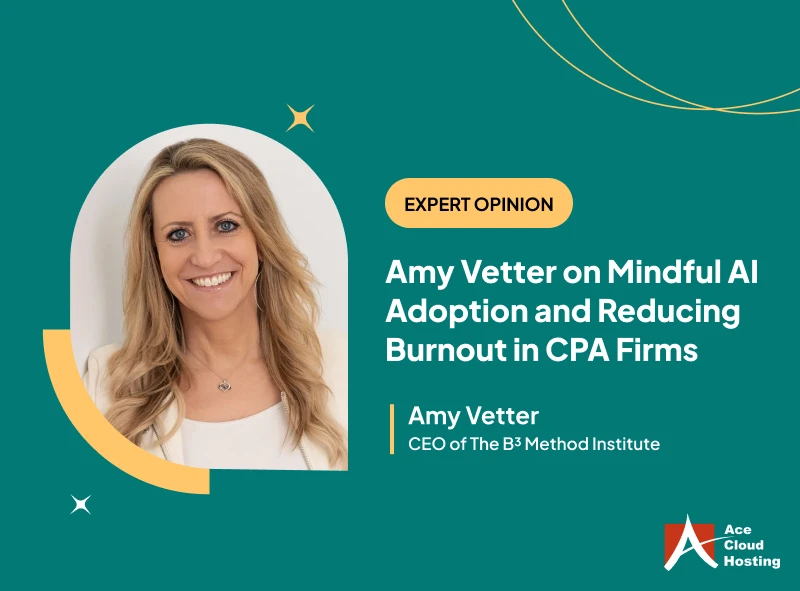
In this insightful session hosted by Ace Cloud Hosting, Seth Fineberg, founder of Accountants Forward, speaks with Amy Vetter, CEO of The B³ Method Institute, CPA, keynote speaker, and entrepreneur, about how accounting firms can adopt AI with purpose while reducing burnout and creating a more balanced workplace.
With her experience combining financial technology with workplace wellness, Amy brings a practical perspective on how firms can use technology to improve efficiency without adding more pressure to already stretched teams.
During the conversation, Amy and Seth explore the causes of burnout in the accounting profession, the importance of mindful technology implementation, and how leaders can build a clear plan before adopting new AI tools.
They also discuss creating repeatable processes, evaluating the human experience behind technology, making better use of existing software capabilities, and using AI to free up time for deeper client relationships and truly advisory work.
Transcript
Seth: Hi, Seth Finberg here once again for Ace Cloud Hosting. I once again have an awesome, very special guest with me here today, Amy Vetter. Amy Vetter is going to go into a bit of her background, and we’re going to lean in today on “AI Adoption with Purpose, a Mindful Way to Reduce Burnout in CPA Firms.”
So, lots of discussion around AI these days about the real basics, like: what should we be doing? What can it do? What shouldn’t it do?
But when you talk about it from a perspective on really how firms can adopt AI and modern technology without really adding more pressure to already stretched teams, that’s significant. So, Amy, thank you so much for being here today. Why don’t you just give a quick background on yourself and your role in the accounting profession these days?
Amy: Sure. Well, thanks.
Seth: For those who don’t know you.
Amy: Yeah. I appreciate you having me. I am a CPA. I’m also a Yogi. I’ve been a certified yoga teacher for 20 years, and I brought that together in my company called the B3 Method Institute, which is business plus balance equals bliss. And our mission has been to transform these workplaces since I began the business in 2018.
And we do it in a number of ways through speaking, coaching, consulting, and all sorts of other types of offerings as well. So that’s what we do.
Seth: Excellent. So, you’ve been an integral part of the profession, both on the vendor side and on the firm side. And now coaching and really kind of helping people, you know, be grounded, be centered. You’ve come up with a whole, you know, methodology.
We’re really at an inflection point, safe to say, in the economy profession today; people want to move forward in the best ways. We saw it with cloud as a disruptor, and now we’re seeing it with AI.
So, what would you say contributes the most? And it can be overwhelming. Mostly, most of the profession is filled with small firm owners and leadership, and they’re feeling it left, right, and center.
What would you say contributes the most to burnout in the accounting profession, and why isn’t more really done about it?
Amy: I think it’s a belief system that this is just the “profession”.
Seth: Sure.
Amy: That, you know, for many years, this is how accountants have worked, and it is why I started my business in the first place, because I believe they could be done in a better way. And what happens when you have those belief systems is that it perpetuates through the organization that you think, oh, well, once one generation retires out, then the next generation won’t think that way.
But they do, because they’re trained by the prior generation, and that’s kind of told to them in order to be successful, in order to achieve here: this is the way you have to work and the way it is. And there’s a difference between a belief system and what is inherent in ourselves, whether we actually observe that we don’t feel congruent with that belief system. We might push it down and, you know, ignore the feeling.
But that is really what I tried to uncover with people is to actually observe the fact that is this belief system really aligned with who you are today, with the things that you know today, and what is actually preventing you from moving forward individually, because leaders have to go through that themselves in order to lead others into the change that we have occurring in this profession in so many ways.
Seth: And one of the things, too, is, you know, we talk about the feeling of burnout, feeling overworked, and along comes AI, which has, I think, the ability to legit actually tamp down some of that stress and even take away some of the you no longer have to do this.
I’m wondering, from your perspective, what are some of the most common contributors or pitfalls when it comes to this burnout that so much of the profession experiences? And how can technology help? How are you seeing it help? Really?
Amy: Well, it really depends. Again, coming back to the leaders, how good they are at stepping back and creating a plan, because what it can be is just chaos. And if it’s just try anything you know, or putting AI in place before you’ve actually tested it. And a small group of clients to the side, without putting it into operations first.
There should be clear objectives you’re trying to accomplish with the AI, not just, oh, this tool can do it faster, but what does that mean? And what doesn’t it do? So that there are processes put into place and training put into place for what you need to check. Where are the gaps, and where is the human side of the relationship?
The second thing that I see happening is actually revenue being lost in firms because you brought it up, you know, for years with the cloud, we’ve been talking about advisory and how important advisory is. And part of advisory is coming up with better pricing, packaging, and getting really clear on your processes.
If you didn’t do that, then now if AI comes in and you’re still billing by the hour and it’s taking less time and you didn’t build in a full client relationship and value beyond the compliance, then you’re actually losing revenue at the same time that everyone’s feeling the stress of, you know, worried about their job, worried about if they’re smart enough right now to do all these new tools and things without really getting the support that they need to be successful.
Seth: That’s a great point about just feeling that, feeling like, oh, I’m not confident enough to jump into this. And it is interesting. Staying on the topic of AI, how many more practitioners are there in the early days that I’m seeing? I don’t know if you’re seeing it kind of lean in a bit more than with the cloud.
I felt like, with cloud hosting, when it first came out, it was, why would I do that? I don’t know what this is. I already have the software that I need right here on my own servers, on my own computer. I know where all my data is. Now you’re asking me to put it somewhere else? No, thank you.
That seemed to be the collective, you know, other than the handful of folks that are like, oh, this actually, we can work in real time with our clients now and with our teams in, you know, in multiple offices, you know, if you were a bigger firm, and why wouldn’t we do that?
But it took years, and so right now, I think you made a great point about, you know, the process that needs to change. Your whole plan needs to change if you’re going to be leaning in. Well, that brings me to my next question.
The role of technology, particularly in accounting, is often seen as a Band-Aid. You know, you’re just kind of solving for these little cuts, you know, but you’re not digging deeper and dealing with, you know, the myriad of pain points.
What are your thoughts on this analogy, especially with the rise of AI, so that maybe it’s not just more serious Band-Aids, which is kind of how we got the tech stack – of course, tech stacks that can kind of get out of control. Why do we need all this?
Amy: Yeah. Well, again, this comes back to a plan and stepping back, if you have this opportunity to design your business that you’ve never had before. So, if you threw out everything that you have before and said, you know, how would I want this to work? How many hours a week do I really want people to have? What kind of revenue do I need? From a top-line business strategy perspective, what do I want?
And then build the technology toolkit, whatever you’re going to do based on what you want. Too many times, we’re led by the vendor and, you know, it’s like, oh, this nice shiny object. Let’s try that.
Seth: I have a solution for you.
Amy: Yeah. Instead of really understanding the whole ecosystem, we have, and if we have, like, too many licenses in the same department, with everyone using different things to solve different things, that then isn’t a repeatable process, and we’ll never get to value pricing.
So, the whole point of really making this efficient is so that you’re actually creating a system in your business where it’s repeatable, that people can be trained on it, and you understand the desired outcome that you want, which is between, you know, quality of life, the kind of quality you want clients to have, and relationships that you want clients to have.
And building backward from that versus trying to pick all these tools. And I would say the second thing that I’ve really seen as an issue is, you know, a lot of funding for new technology to flood the market with, like, neat, shiny objects.
But what I haven’t seen is that people actually go back to the vendors that they’re already using and truly understand the AI that’s within the application. You know, in my years of technology work, what I find is people use like 5 to 10% of what the software is capable of, and they don’t keep up with all the releases and the updates, and they don’t have someone assigned in the organization to do those things.
And the problem is we start adding all these little tools without even knowing the system that we have in place. Is there a way to rework our process with the latest releases that they have, and then understand the gaps versus making assumptions?
Seth: Yeah, and just, you know, maybe there’s an opportunity now for a more collaborative thing to really happen where the accountant can actually play a bigger role in where the technology goes because there’s an understanding of how they work, exactly how they work.
We saw this with practice management systems over and over again. So many people get frustrated with them. And something that’s so integral to how a firm functions. Yet there’s so much dissatisfaction, or even frustration, with the fact that it doesn’t do this. I really needed to do that. And maybe if there was more of that collaboration.
Which brings me to my next point. When we talk about this idea of mindful implementation, when it gets down to, okay, I’m going to go forward with something, what’s involved there from a leadership perspective.
Amy: It’s truly understanding the human experience with technology, not just the technology itself. So I think, you know, if we look at tax software, we’ll say, you know, what tax returns it does, but we’re not actually looking at, well, what would be the experience between the client and us and what would be the experience internally between different staff people, the reviewer, the partner, what does that experience look like and who are we involving in that testing process to make sure that we’re happy and that it creates delight.
That it’s not just because it can do a thing, because if people don’t enjoy being in that software, it takes more clicks, or they can’t find the information that they’re looking for, it’s not going to solve the problem at the end of the day. And I think too many times we’re into, like, the thing that it does versus the experience that it creates.
Seth: Yeah. And you know, so outcomes, really, I think, are the name of the game. It’s like what. You know, what are you actually producing, meaning, for the client, for your teams? How are they feeling? Which brings me to my last question here.
You know, technology can’t solve all human issues. Yet we’re hearing about AI itself already being touted as making or allowing accountants to be more human. Weigh in on that.
Amy: I don’t think AI creates accountants to be more human. We have to be open to learning how to have the relationships that are needed, because AI frees up the time. So, I think you know what I mean. If I have individual conversations with people, there’s a fear that time won’t be available, right?
Like, what do I do with that time? Like, I like to work. So, I’m going to stop working. Suppose I like to work and admit to that. And then it’s also: how do I create a strong relationship with my client that I’m giving advice, because that time is freed up, and that is really the opportunity with AI. And it’s been the opportunity, you know, with the cloud, to move to the space that we are in- AI- to be truly advisory.
For me, the problem is that so many people have been called advisors who aren’t advisors, you know, in the profession where trusted advisors are. However, that trust was basically providing information that is very confidential to your CPA or your accountant, your EA, whoever you’re dealing with.
But that doesn’t mean you had an advisory relationship where you actually were providing advice and had real touchpoints that were scheduled with the client, and how you ran those conversations, and how you listen and provide feedback and give space to that without rushing the conversation. That is a skill; even though it’s called a soft skill, it’s a hard skill, and it needs to be trained just like the technical aspects of using the technology.
Seth: It sounds like we have an opportunity. All of that technology is providing is a more efficient way to work, so that we can spend more time with our families, ourselves, and our clients. And that’s kind of what I think I meant by being more human, meaning it’s opening the door for the work that you do to actually become more human, more interactive, and less, “oh, I’ve got to log into this portal and check these boxes and then send these documents out.”
And that’s work done, the work that you do. That’s changing. That’s how I see it. Final thoughts, Amy: this has been really great. And I wish we could talk for more because I have a lot more things I would love to get. But this is our time. So, I just want to see if there are any final thoughts from you.
Amy: Yeah, I think this is providing, you know, something that, you know, we’ve all been out there talking about for so many years of really moving into advisory services, whether that’s client accounting, tax, wealth management, whatever you’re in and it is going out of rapid pace where it’s no more a question of like, can I put my heels in the sand and avoid this and continue to do what I’ve always done, versus I’ve got to speed up the process of the human side of this.
Seth: Excellent, Amy, thank you so, so much for taking your time with us today. Seth Fineberg, again, for Ace Cloud Hosting. Have a great day.
Amy: Thank you.
Subscribe to Ace Cloud Hosting today to receive expert content, practical advice, and thought-leadership insights that help businesses stay competitive, secure, and future-ready.
Responsible AI adoption starts with secure, reliable infrastructure. Ace Cloud Hosting helps CPA and accounting firms explore AI without exposing local devices or giving agents unrestricted access to sensitive client data. Automate workflows, process documents, summarize information, and work with hosted accounting applications inside an isolated, managed workspace.

2027 Tax Season Readiness Survey
Is Your Firm Ready for the 2027 Tax Season?
Share how your firm is preparing its technology, security, and workflows. Your input will help shape an industry benchmark.
$500
Chance to win Amazon Gift Card
100% Confidential & Secure
5 minutes to Complete