Table of contents Toc Icon
Table of contents Toc Icon
Accounting firms are already using AI to summarize documents, analyze data, draft communication, and support research. Agentic AI takes the next step by allowing AI systems to complete multiple actions toward a defined goal with less manual prompting.
For accounting firms, that could mean an AI agent that gathers documents, matches transactions, checks predefined rules, prepares a reconciliation, and sends only exceptions to an accountant.
The opportunity is significant, but so is the responsibility. Once AI can interact with accounting applications and client data, firms need clear controls over what it can access, what it can do, and when a human must take over.
The same principle applies to the infrastructure around those workflows, because firms need a controlled way to connect AI tools to internal systems without creating new confusion or risk. An AI gateway can help standardize how those connections are managed as adoption expands.
This guide explains how accounting firms can implement agentic AI in a controlled, practical way.
What Is Agentic AI in Accounting?
Agentic AI refers to AI systems that can work toward a defined objective, determine the steps needed to achieve it, interact with approved tools or data sources, and take actions within predefined boundaries. This distinguishes it from the generative AI tools accountants have become familiar with.
A generative AI tool might analyze an invoice and extract the vendor name, amount, due date, and line items. An agentic workflow could use that information to validate the vendor, compare the invoice with a purchase order, identify discrepancies, check approval requirements, and route the invoice to the appropriate reviewer.
The difference is therefore not simply better analysis. It is the ability to connect analysis with workflow execution.
Traditional accounting automation also performs actions, but usually according to predetermined rules. Agentic AI becomes useful when the process involves multiple steps, changing conditions, interpretation, or selecting the next appropriate action based on available information.
For accounting firms, the most important difference is authority. The more actions an AI agent can perform, the more carefully its permissions, oversight, and accountability need to be designed.
Why Agentic AI Matters for Accounting Firms?
Accounting professionals spend a lot of time on work that supports accounting judgment rather than on work that requires it.
Documents need to be collected. Transactions have to be compared. Clients need reminders. Workflow statuses require updates. Reconciliations have to be prepared before exceptions can be reviewed.
Agentic AI can potentially handle more of this coordination layer while accountants remain responsible for decisions that require experience and professional judgment.
The market is already moving in this direction. A 2025 Deloitte Center for Controllership poll found that 80.5% of finance and accounting professionals expected AI-powered tools, including AI agents, to become standard within five years, while only 13.5% said their organizations were already using agentic AI. Trust and integration with existing systems were among the main barriers.
The question is not how many AI tools a firm can deploy. It is where an AI agent can genuinely reduce repetitive work without weakening control.
Run accounting apps, data, and AI workflows in one controlled cloud environment.
Where Can Accounting Firms Use Agentic AI?
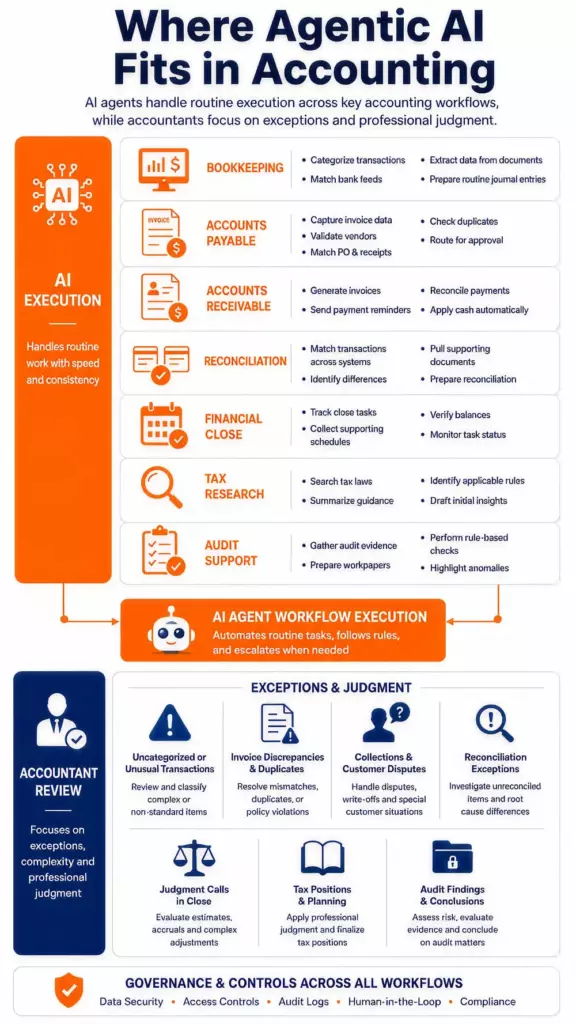
The best early use cases generally involve high-volume processes with repeatable steps, clear rules, and identifiable exceptions.
Bookkeeping and Transaction Processing
An AI agent can potentially analyze transactions against predefined policies and historical classifications, locate supporting documents, process routine items, and send uncertain transactions to a bookkeeper for review.
Instead of examining every transaction with the same level of effort, professionals can concentrate on exceptions and unusual accounting treatments.
Accounts Payable
Accounts payable is well-suited to AI automation because invoices move through several predictable stages. An agent could extract invoice details, validate vendors, identify duplicates, compare invoices with purchase orders, apply approval rules, and route exceptions. The agent does not need authority to make the payment. It can automate routine processing while keeping financial approval with the appropriate employee.
Reconciliation and Financial Close
Reconciliation involves a large amount of matching before an accountant reaches the items that actually require investigation.
An agent could compare records, match routine transactions, find supporting documentation, identify unexplained differences, and prepare exceptions for review.
The same approach can extend to the financial close. AI agents could track outstanding tasks, identify incomplete reconciliations, gather supporting documents, and flag unusual balances.
Gartner predicted in February 2026 that finance organizations using cloud ERP applications with embedded AI assistants could achieve a 30% faster financial close by 2028.
Tax and Audit Support
Agentic AI can also support research- and documentation-heavy work. For tax teams, an agent could gather relevant client information, search approved research sources, identify applicable guidance, and prepare an initial analysis with references.
In audit workflows, AI agents can assist with document collection, predefined checks, evidence preparation, and anomaly identification.
The critical distinction is that AI supports the process while the tax professional or auditor retains responsibility for conclusions requiring professional judgment.
How to Implement Agentic AI in an Accounting Firm
Step 1: Choose the Right Workflow
Begin with the process that is repetitive enough to justify automation.
Reconciliation, invoice validation, document collection, AR follow-up, and routine transaction processing are generally better starting points than highly subjective processes such as complex tax planning.
Map the workflow from start to finish. Example for accounts payable:
Invoice received → Data captured → Vendor validated → PO checked → Exception reviewed → Approval obtained → Transaction recorded
Then determine where time is being lost, where rules are consistent, which steps require judgment, and which exceptions regularly interrupt the process. This matters because agentic AI should not be used simply because it is available.
Gartner predicted in 2025 that more than 40% of agentic AI projects could be canceled by the end of 2027 because of escalating costs, unclear business value, or inadequate risk controls.
If simple rules-based automation can solve a workflow effectively, an AI agent may add unnecessary complexity.
Step 2: Clearly Define the Agent’s Role
Avoid giving the agent a broad responsibility such as “manage accounts payable.” Define exactly what it should accomplish. For example:
Review incoming invoices, validate vendors against approved records, compare invoice details with corresponding purchase orders, and send mismatches to an AP reviewer.
This gives the agent a measurable responsibility and makes the next decisions easier: what information it requires, which applications it needs, what actions it can perform, and where human approval is necessary.
Step 3: Decide What the Agent Can Do Independently
Not every AI action requires human approval, but not every action should be autonomous either. A practical way to determine autonomy is to consider the impact if the agent gets something wrong.
AI handles routine execution. Accountants become involved when uncertainty, materiality, or professional responsibility increases.
Step 4: Restrict Access to Accounting Data and Applications
An agent capable of taking action should be treated like another identity within the firm’s technology environment. It should receive only the access required for its role.
An accounts receivable agent, for example, may need access to invoices, customer balances, payment histories, and approved communication tools. It does not need access to employee payroll data or unrelated client tax files.
For every agent, firms should define what it can read, create, modify, communicate externally, trigger in another application, and approve.
These boundaries become particularly important as AI models connect with applications through APIs, automation platforms, or Model Context Protocol servers.
The risk is not only what the AI model knows. It is also what the agent can reach and what those connected tools allow it to do.
Step 5: Define When Human Intervention Is Required
Good agentic AI implementation is not about eliminating human involvement. It is about placing humans at the points where their involvement is valuable.
An AI agent might complete routine work independently but stop when a transaction exceeds a threshold, required documentation is missing, two systems disagree, confidence is low, or a financial or professional judgment is required.
The workflow then becomes:
This approach avoids two extremes: giving AI excessive autonomy or forcing accountants to approve every minor action.
Step 6: Put AI Governance and Security in Place
Governance becomes more important when AI moves from generating information to performing actions.
A firm should know who owns each agent, who can modify its permissions, what data it can process, which AI platforms are approved, how actions are logged, and how access can be revoked.
The issue is still developing across enterprises. Deloitte’s 2026 State of AI research reported that only one in five organizations had a mature governance model for autonomous AI agents.
Security needs equal attention because accounting firms handle financial records, taxpayer information, personally identifiable information, payroll records, bank details, and confidential client documents.
Agentic AI should therefore be integrated into the firm’s existing security controls, including MFA, role-based access, encryption, monitoring, endpoint security, audit logging, backups, and vendor assessment.
For tax practices, the IRS also directs tax professionals to Publication 4557 and the FTC Safeguards Rule regarding taxpayer-data protection.
Ace Cloud Hosting discusses these considerations further in its guide to AI and data privacy in accounting firms.
Step 7: Build the Right Environment for Agentic AI
Agentic AI becomes more complex once it starts interacting with accounting applications, client files, tax software, and other business systems. At that point, firms need to think not only about what the AI agent can do, but also where those interactions take place and how access is controlled.
A centralized cloud workspace can give accounting firms a more controlled environment for introducing AI into operational workflows. Instead of relying on employee laptops or separately managed systems, approved accounting applications (QuickBooks, Sage, and more), files, users, and AI-connected workflows can operate within a centrally managed environment. This can help firms apply consistent controls around:
- Role-based access: Limit employees and AI agents to approved applications, files, and resources.
- Isolated workspaces: Keep business applications and client data within the secure cloud environment rather than depending on local endpoints.
- Controlled AI integrations: Connect approved AI tools, APIs, or MCP servers only to the systems required for a specific workflow.
- Centralized security: Apply MFA, access policies, monitoring, endpoint protection, backups, and other safeguards across the environment.
- Scalable deployment: Expand computing resources and application access as AI workloads or teams grow without redesigning the entire desktop environment.
For example, an AI agent supporting reconciliation may need access to accounting software and selected financial documents. But it does not need unrestricted access to every application or client file. In a controlled cloud environment, those permissions can be designed around the agent’s specific role.
The purpose of moving Agentic AI workflows into the cloud is not only remote access. It is to create a controlled operating environment where accountants and approved AI agents can work with business applications while maintaining defined boundaries around data, access, and actions.
This becomes increasingly important as firms progress from using AI for isolated tasks to allowing AI agents to participate in real accounting workflows.
Step 8: Pilot, Test, and Measure Before Scaling
Before giving an AI agent access to live workflows, test it against completed cases where the correct outcomes are already known.
Do not test only normal transactions. Introduce duplicate invoices, missing documents, conflicting information, unusual transactions, and situations where the agent should refuse to proceed.
A successful agent should not merely complete routine tasks correctly. It should also fail safely when the workflow falls outside its assigned boundaries.
Once the results are reliable, introduce limited live use and measure the accounting outcome. Depending on the workflow, metrics can include processing time, manual touches, exception rates, correction rates, reconciliation time, close duration, or employee hours saved. Avoid measuring success based solely on the number of agents or employees using AI. The process should become measurably better.
Agentic AI Readiness Checklist for Accounting Firms
Before deploying an AI agent into an accounting workflow, firms should have the answers to the questions below:
- What specific problem is the agent solving?
- Why does this process need agentic AI rather than standard automation?
- Which steps can AI perform?
- Where is professional judgment required?
- What applications does the agent need?
- Which client data can it access?
- What can it create or modify?
- Which actions require human approval?
- What conditions force the agent to stop?
- Are important actions logged?
- Can an incorrect action be reversed?
- Who owns the workflow?
- Who controls the agent’s permissions?
- How will errors and performance be measured?
- Can access be revoked immediately?
If these questions do not have clear answers, the process may not yet be ready for agentic AI.
Create a secure, scalable cloud environment for your accounting apps and AI workflows.
Moving from AI Experimentation to Agentic Accounting
As firms move from AI experimentation to real workflows, success will depend on more than choosing the right agent. Firms also need clearly defined roles, controlled access, human oversight, and an environment where applications, data, and AI interactions can be managed securely.
Thomson Reuters’ 2026 AI in Professional Services Report found that organization-wide AI adoption increased from 22% in 2025 to 40% in 2026. 15% of organizations were already using agentic AI, whereas another 53% were planning or considering it.
Thus, choose the right workflow, define the agent’s role, control its access, keep professional judgment with accountants, and scale only after testing and measurement.