Table of contents Toc Icon
Table of contents Toc Icon
AI is changing bookkeeping quickly, but faster work is not automatically better work. As more transaction-level tasks become automated, the real value of the bookkeeper is shifting toward validation, judgment, interpretation, and knowing when an AI-generated result should not be trusted.

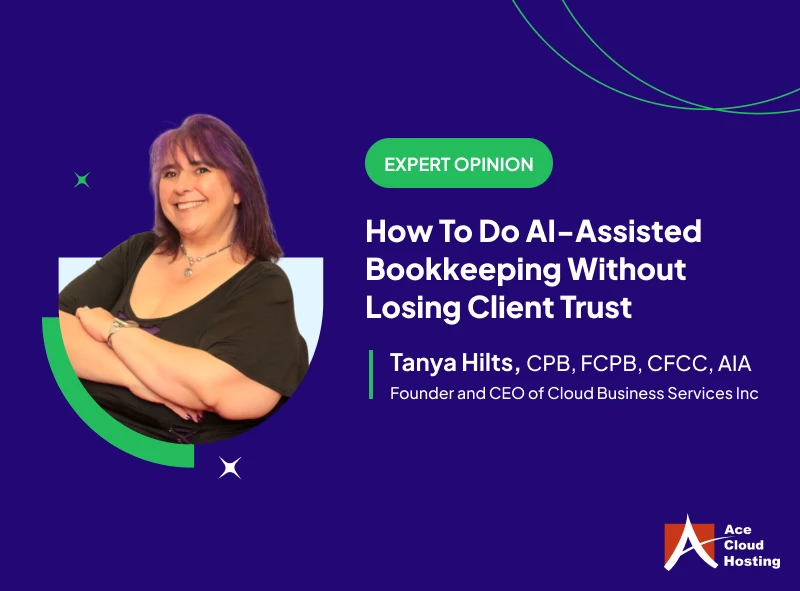
To explore how bookkeeping firms can adopt AI without weakening accuracy or client confidence, Ace Cloud Hosting spoke with Tanya Hilts, CPB, FCPB, CFCC, AIA, Founder and CEO of Cloud Business Services Inc., and founder of Tanya’s Bookkeepers’ Bootcamp.
Tanya works directly with bookkeepers and business owners on stronger workflows, financial clarity, and responsible AI adoption.
Her approach is grounded in a simple principle: AI should take time-consuming work off a bookkeeper’s plate, but it should never replace professional judgment.
Through her AI Bootcamp for Bookkeepers, Tanya teaches firms how to apply AI inside real workflows while maintaining privacy, validation, accountability, and human sign-off.
1. As AI takes over more transaction-level work, what should bookkeepers stop doing, and what should they become better at instead?
Bookkeepers should stop treating this as a “junior work vs. senior work” question — that’s the wrong split. The real line isn’t skill level; it’s time-consuming vs. validated. Categorization, reconciliation prep, first-pass summaries, anomaly flags — these show up at every level of the job, and AI can take the time-consuming part off all of them.
What bookkeepers need to get better at is the validation itself: knowing what “right” looks like well enough to catch what isn’t.
My rule with my own team is simple — if you can’t do it manually, you can’t validate it, and you have no business using AI to produce it for a client. AI doesn’t shrink the bookkeeper’s role to the easy stuff. It shrinks the doing, so more of the job becomes judgment.
2. When bookkeepers use AI with client data, where should the line be drawn between automation and human review?
AI drafts; it doesn’t verify. That’s the line, full stop. I let AI touch drafting, first-pass computation, and summarizing — anything that produces a starting point. I never let it touch sign-off. And I build the review in at every step of a workflow, not just at the end — if a task has three stages, there are three checkpoints, not one.
The test I use: if we don’t want AI replacing bookkeepers, we can’t turn around and use it to replace the judgment of a lawyer, an accountant, or anyone else’s licensed sign-off. AI can draft a clause. It still goes to a lawyer.
3. Which AI use case is delivering the most practical value for bookkeepers today and which one is still overhyped?
The most overhyped use case right now isn’t in bookkeeping specifically — it’s the broader trend of using AI to generate images and videos of ourselves, and I think it’s going to be genuinely detrimental long-term. Too many people are handing AI unlimited creative reign the way you’d hop a kid up on sugar and let them loose in a candy store — full permission, no validation, no responsibility attached.
The result is that authenticity is disappearing. I don’t trust video content anymore, because I have no way of knowing what’s real. When I do see someone’s actual, imperfect self on camera, I pay attention — because it’s becoming rare. I’d rather use a stock photo than an AI-generated image of a real person. That’s a line I hold for myself, and it’s a line I teach.
The practical value, by contrast, is in analytical work — the deep, structured reasoning that used to eat hours: diagnostics, financial analysis, working through long or complex documents. That’s where AI earns its keep for bookkeepers, and it’s exactly why “validate everything, automate nothing blindly” is the whole foundation of the AI Bootcamp for Bookkeepers I built.
I’m not teaching this as a hype cycle. I’m teaching it as a discipline, because the bubble around the flashy stuff—the videos, the synthetic selves—is going to burst. What won’t burst is a bookkeeper who knows how to use AI to handle the time-consuming work responsibly, validate the output, and stay recognizably, authentically themselves while doing it.
4. For remote or cloud-based bookkeeping firms, what guardrails should be in place before AI becomes part of daily work?
A few non-negotiables: confirm-before-execute, so AI shows its reasoning before it acts rather than just producing an answer. A validation checklist that scales with the complexity of the task — a quick gut-check for simple output, a full show-your-math review for anything analytical. And a boundary the AI is explicitly instructed to hold: it can push back, play devil’s advocate, lay out pros and cons — but it doesn’t generate original ideas or IP on the firm’s behalf.
That’s the owner’s job. Firms also need a plan for client data specifically — reviewing what a tool’s terms actually say about data use before it touches client files, not after.
5. As AI changes bookkeeping, where do you see the biggest opportunity for firms that adapt early?
Small firms have a real edge here, and it’s not a consolation prize — it’s structural. Small means fast, focused, and niche, which is exactly the profile that can adopt new tools quickly while larger firms are still in committee.
But the bigger opportunity is longer-term than that, and it’s about who’s still standing when the hype settles. We’ve seen this pattern before — the dot-com crash, and every bubble like it. The businesses left standing afterward weren’t the ones that chased the noise fastest.
They were the ones that built for long-term gain instead of short-term excitement. AI is no different. Right now, there’s a lot of “hand everything over to it” energy, and when that bubble bursts, the firms caught out will be the ones that skipped the validation step and signed their name to work they never actually checked. That’s not an AI problem at that point — that’s a reputation problem, and it’s self-inflicted.
The firms that adapt early and adapt responsibly — full validation, full self-checking, human sign-off on everything that leaves the building — are the ones building something durable. That’s the whole opportunity: not being first but being the ones still trusted when everyone else’s shortcuts catch up with them.
Run AI-assisted accounting workflows in a secure, managed cloud workspace built for modern firms.
AI Should Reduce the Doing, Not the Judgment
Tanya’s perspective draws a clear line between automation and responsibility. AI can help with categorization, reconciliation preparation, summaries, diagnostics, document analysis, and other time-consuming work. But the professional using it still needs to understand the underlying task well enough to recognize when the output is wrong.
That makes validation a core skill for the AI-assisted bookkeeper. Tanya’s rule is straightforward: if someone cannot perform the work manually, they are not in a strong position to validate an AI-generated result. As AI handles more of the initial preparation, bookkeepers need to become stronger at review, context, and judgment.
For firms adapting early, the advantage may not come from automating the most work the fastest. It may come from building a disciplined approach that clients can continue to trust. When AI handles repetitive preparation and people remain accountable for what leaves the firm, bookkeepers can gain capacity without giving up the human judgment that gives their work value.
Responsible AI adoption starts with secure, reliable infrastructure. Ace Cloud Hosting helps CPA and accounting firms explore AI without exposing local devices or giving agents unrestricted access to sensitive client data. Automate workflows, process documents, summarize information, and work with hosted accounting applications inside an isolated, managed workspace.