Table of contents Toc Icon
Table of contents Toc Icon
Accounting firms are investing heavily in AI, but adding new tools does not automatically create a modern firm. When outdated workflows, fragmented data, and institutional knowledge remain unchanged, AI may simply accelerate the same problems firms already have.

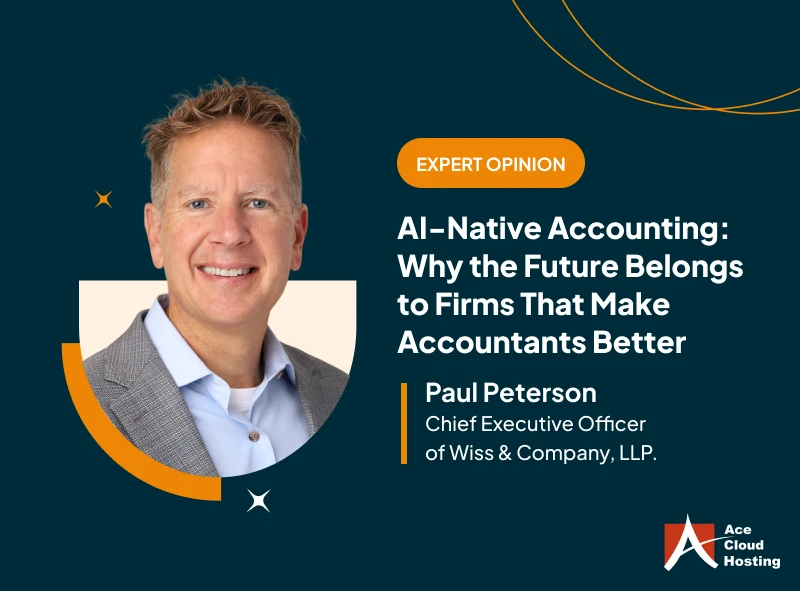
To explore what it truly means to become AI-native, Ace Cloud Hosting spoke with Paul Peterson, Chief Executive Officer of Wiss & Company, LLP. Paul leads the firm’s strategy, growth, and investment in the future of the accounting profession.
His focus is not on using AI to replace professionals, but on strengthening their judgment, expanding their capabilities, and improving the experience they deliver to clients.
Through initiatives such as Wiss Labs and The Intelligent Ledger, Paul advocates for an operating model where technology, leadership, and professional development work together.
His approach protects the mentorship, accountability, and trust at the heart of accounting while challenging firms to rethink how work is designed.
In this conversation, Paul explains how AI-native accounting differs from simply adding tools to old workflows, how AI can accelerate the development of younger accountants, and why firms that invest in people will create more value than those focused only on reducing headcount.
1. What does “AI-native accounting” actually mean, and how is it different from a traditional firm simply adding AI tools to old workflows?
Bolting AI onto a broken process just gives you a faster broken process. That is the difference. Most firms are buying tools and layering them onto workflows built for a company and an era that no longer exists. AI-native means you start the other way around.
You redesign the process first, on a clean foundation, and then you build intelligence into it. At Wiss, we run an AI Readiness Assessment before we touch the technology. Process mapping, data cleanup, clear ownership, then the AI. It sounds like the slow path. It is the fast one, because the firm that skips to the tool ends up back where it started, running the same broken process on a newer system.
The deeper distinction is where the intelligence lives. In a traditional firm, it sits in the ERP and in a few people’s heads. AI-native means the firm captures that judgment and context as an asset it owns, so the work compounds instead of resetting every time someone leaves.
2. You’ve said AI should make accounting better for accountants and clients. What does that look like in real client work?
It looks like the accountant staying in control while the machine handles the parts that never needed a human. AI reads the long document, ties out the feed, drafts the first pass of the variance commentary, and flags the exceptions. The accountant does the judgment, the interpretation, and the conversation with the client. The senior still signs every deliverable, and that signature is the whole point.
You can sue an accountant. You cannot sue a chatbot. The accountability, the trust, and the relationship stay with the human. For the client, it means faster answers and, more importantly, better ones. When the team is not buried in reconciliation and data entry, it has room to actually advise. The close that used to land days late lands on time, with someone who can explain what the numbers mean.
For the accountant, the leverage on a strong professional goes up, not down. The same person serves more clients, at a higher level, and spends their time on the work that drew them to the profession in the first place.
3. How can firms use AI to develop younger accountants faster, instead of taking away the work that helps them learn?
This is the question I worry about most. The grunt work is also the training ground. It is where a young accountant learns why the books close the way they do. Take all of it away, and you risk a generation that never develops judgment, because judgment cannot be downloaded. It has to be developed.
So the goal is not to delete the learning reps. It is to change what they are practicing. AI can absorb the mechanical repetition and free a first-year to spend their time on the reasoning: why is this variance here, what would the auditor flag, how would you explain this to the CFO. That is the apprenticeship, moved up a level. Used well, AI is also the patient senior who is always available. It can show the work, explain the technique, and answer the second and third question a junior is too nervous to ask a partner at nine at night.
At Wiss, we built an internal AI Academy for exactly this reason. The master teaching the apprentice is the most fragile part of our profession. AI should protect it, not erase it.
4. What do you think firms get wrong when they treat AI mainly as a cost-cutting tool?
They are making a bet against the accountant, and it is the wrong bet. Three groups are placing it at once: the consolidators buying firms to shrink the labor line, the offshoring shops selling cheaper hands, and the AI vendors selling headcount cuts. One identical wager. Shrink the people, expand the margin.
The math does not hold. The value in this profession does not live in the software or the workflow. It lives in the accountant who knows why this client does things the way they do, and what the auditor flagged three years ago. Strip that person out and you have not saved money. You have thrown away the moat. What the cost-cutting frame misses is that AI expands the pie; it does not shrink it.
The leverage on a strong accountant rises. The firm can do more, and the team can do more at the same time. Firms that treat AI as a way to cut people will win a quarter or two, then lose the clients, because they will have automated away the judgment the client was paying for. We are betting the other way.
5. As accounting moves toward real-time insight and advisory, what kind of culture and leadership will separate the firms that lead from the firms that fall behind?
Culture decides this, not technology. The tools will be available to everyone. What separates firms is whether their people run toward the change or hide from it. Leadership has to do two things that sit in tension. Protect the craft and push the change. Protect the apprenticeship, the mentorship, and the standard that says a partner puts their name on the work and stands behind it. And at the same time, refuse to let the firm coast on how it has always done things. Both, at once.
The firms that fall behind will treat AI as an IT project owned by a committee. The firms that lead will treat it as an operating model owned by leadership, with real investment in their people and not only their software.
At Wiss, we stood up Wiss Labs as our innovation arm and filed a patent on capturing institutional knowledge, because we believe the firm that wins is the one that makes its accountants better, not the one with the most tools. Real-time insight is the output. A confident, well-trained team is what produces it.
Host QuickBooks, Sage, and other critical applications in a secure cloud environment built for reliable access, performance, and growth.
How to Build an AI-Ready Accounting Firm?
Paul’s perspective reframes AI in accounting as a way to improve how firms operate, not just to work faster or reduce headcount. To become AI-ready, firms need clear processes, reliable data, defined ownership, and a clear understanding of where professional judgment is required. Without that foundation, AI may increase speed without improving quality.
Building an AI-ready accounting firm also requires the right technology foundation: secure data, reliable access to applications, and infrastructure your team can trust. Ace Cloud Hosting helps accounting firms host their critical applications such as QuickBooks, Sage, and more, securely in the cloud, ensuring the technology is ready when the firm is ready for AI adoption.