Table of contents Toc Icon
Table of contents Toc Icon
Accounting firms have more technology choices than ever, yet buying the right software is only one part of the challenge. The harder part is turning that technology into a way of working that makes life easier for clients, teams, and firm owners.

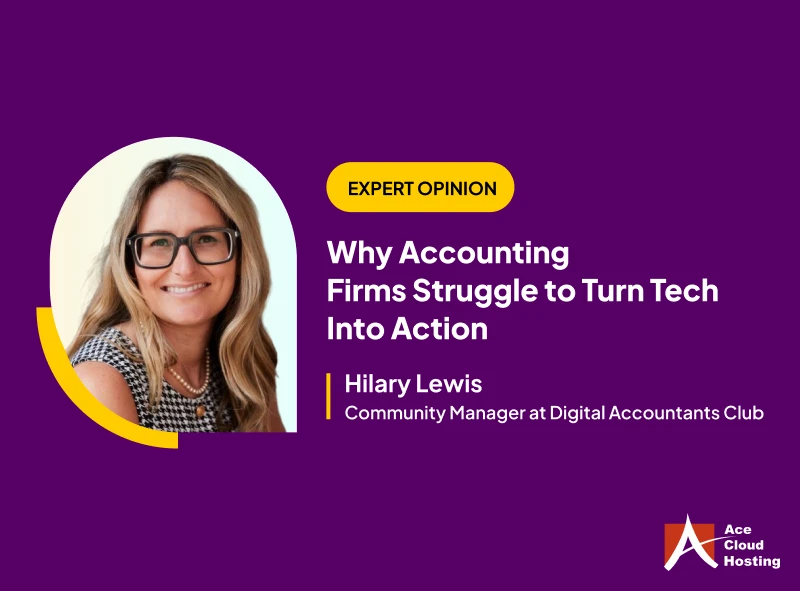
To explore why implementation often falls short, Ace Cloud Hosting spoke with Hilary Lewis, Community Manager at Digital Accountants Club.
With more than thirteen years of experience across marketing, partnerships, community building, and business ownership, Hilary works closely with accounting firms and technology providers to help turn ideas into practical action.
In this conversation, Hilary explains why firms should look at their customer journey and existing processes before adding new tools, why team involvement matters during implementation, how firms can get more from the technology they already have, and how to separate genuinely useful AI from the latest shiny object.
1. Accounting firms have access to more software and advice than ever. Why is implementation still such a big challenge?
I think a lot of the time, the foundations just aren’t there. And I say that with love!
Some firm owners fell into becoming firm owners. Their businesses grew bigger than they anticipated; the industry changed dramatically and incredibly quickly, and they’ve just gone with it. They’ve adapted and struggled through, rather than stopping to ask whether the way they’re doing things is actually working.
At some point, you need to step back and look at your customer journey and internal processes. Are they as good as they could be? Is it easy for clients to work with you? Is your team spending time on things that could be done more efficiently?
You can’t expect AI or a new piece of software to fix everything if the underlying processes aren’t fit for purpose. You’re effectively putting a plaster over an amputation!
I think some owners don’t have the time to step back, while others don’t necessarily see the bigger picture. Both make it harder to turn technology into meaningful change.
Sometimes the first step is working out what’s actually broken in the first place rather than buying something new.
2. How can a firm tell whether it genuinely needs a new tool or simply needs to make better use of the technology it already has?
I’d start with the customer journey. I’m incredibly customer-centric, and I think how easy you make it for people to work with you should dictate a lot of your decisions.
Every barrier or speed bump creates an opportunity for someone to give up, even when they’re an enthusiastic potential customer. Make things easy and simple wherever possible. One click is better than five!
I’d look at the processes behind that journey before shopping for another tool. Where are people getting stuck? Where is time being wasted? Are systems working together properly? Are you making the most of what you’ve already invested in?
I’d also want to understand where the team’s time is actually going. Workload often seems to be largely unmonitored, and without understanding how people spend their time, it’s difficult to know whether you have a technology problem or a process problem.
You might genuinely need new software. But you might discover that the answer is to simplify a process, improve an existing system, or remove an unnecessary step.
I’d always want to understand the problem before deciding what to buy.
3. What are the most common mistakes you see firms make when building or changing their tech stack?
I think one of the biggest mistakes is expecting technology to work without being prepared to give it the time and attention it needs.
Some firms don’t really get stuck into the implementation. They buy the software, but there aren’t enough people on board with the rollout or prepared to adopt new ways of working.
Change can be scary. People get comfortable with how they’ve always done things, and the larger the team, the more complicated it can become to bring everyone along.
The firms that seem to find it easier are the ones where people get involved, have a go, and work together to find processes that work for the business. The people using the systems need to feel they’ve had a say in how those systems fit into their working lives.
I also think firms can be too quick to move on to the next piece of software before they’ve got the value out of what they’ve already bought.
The industry moves incredibly quickly, but businesses need time to implement, learn, and settle into new systems. Constantly adding more technology without getting the foundations right can create even more complexity, rather than solving the original problem.
4. How can firm owners get their wider team to adopt new systems and workflows instead of technology becoming another leadership-only initiative?
For me, it always comes back to communication and understanding.
My background is in marketing, so I think a lot about brand values and the vision for a business. If people understand what the company stands for, where it’s going, and what it wants to achieve for its customers, they have a much better understanding of why a change makes sense.
I can’t stand it when companies stick five words on a wall and call them their brand values. Those aren’t brand values. They’re token words. Your values should be something you live and breathe. They’re the soul of your business.
That matters when you’re implementing technology too. If people understand the vision for the future, they can see why a new system might be the right thing to do, how it fits with the business, and why customers would appreciate the change.
You also need to involve the people affected by the decision. If departments or teams haven’t been heard, or the strategy has simply been handed down to them, you’re making adoption harder than it needs to be.
When everyone understands the purpose and feels part of the process, it becomes much easier to work together and implement changes that actually work.
5. With AI and accounting software changing so quickly, how should firms decide what deserves attention now and what is simply another shiny object?
Just because you can use AI doesn’t mean you should, right?!
We can all be guilty of chucking a call transcript into ChatGPT and asking for a summary of the next steps and a follow-up email. There’s nothing wrong with that, but I think some of the more useful AI capabilities don’t get enough attention.
I’ve got some brilliant AI assistant bots within software platforms I use. They can help me dig around in the background, find specifics, and build things like workflows. I could watch a video, work it out myself, and spend hours putting it all together, but these tools can do a lot of that work in a fraction of the time.
For me, that’s where AI becomes really useful. It helps me do things much faster and unlocks possibilities that would otherwise take me considerably longer.
Of course, you still need to check what you’ve built. I’ve got hundreds of automations and workflows, and I regularly test them, look for flags, and make tweaks. A software update can break a trigger, so you can’t simply build something and forget about it.
I used to be able to build things and leave them alone for six months. Now I’m forever tinkering!
I’d focus on technology that solves a genuine problem or gives you a meaningful advantage, rather than adopting something just because everyone is talking about it.
Give your team secure, seamless access to essential accounting applications with Ace Cloud Hosting.
Turning Technology Into Real Change
The gap between buying technology and getting value from it is often what happens after the purchase. New systems need time, attention, and regular review. Firms also need to be willing to simplify what is not working instead of continually adding another tool to the stack.
That becomes even more important as AI and automation evolve. Workflows cannot simply be built and forgotten. They need to be tested, adjusted, and checked as software changes and the needs of the firm evolve. The firms that make technology work are often the ones willing to keep refining how it fits into the business.
Once firms know which applications support that way of working, they also need reliable access to them. Ace Cloud Hosting provides secure cloud hosting for accounting firms, helping teams access the applications they rely on in a flexible cloud environment built to support day-to-day work.