Table of contents Toc Icon
Table of contents Toc Icon
Many CPA firms are already using AI assistants such as ChatGPT or Claude for research, writing, and routine tasks. These tools help people access information and produce first drafts faster. The accountant still directs the prompt, reviews the output, and decides what happens next.
AI agents can take on a larger role. They can follow instructions, use approved tools, and complete steps across a process that once required several manual handoffs. This could change how firms handle meeting preparation, email organization, scheduled research, and, over time, more central areas of firm operations.
The opportunity is real, but so is the risk. Agentic AI is still in its early stages, and firms need to understand its limits before giving it access to client information or allowing it to act inside important workflows.

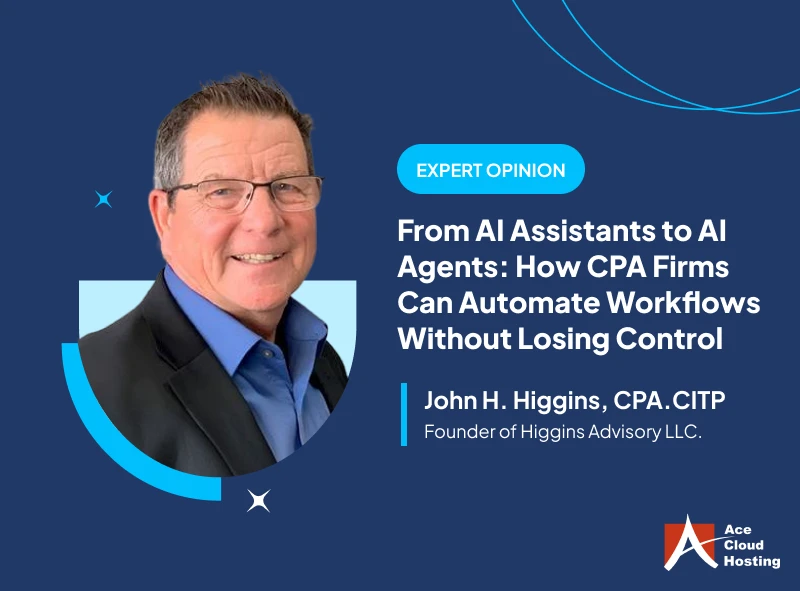
To explore what this shift means for the profession, Ace Cloud Hosting spoke with John H. Higgins, CPA, CITP, founder of Higgins Advisory LLC.
John helps CPAs and CFOs understand artificial intelligence and other emerging technologies. He believes firms must move beyond using AI only for “thinking” and begin preparing for a future where AI can also support the “doing.”
In this conversation, John explains where CPA firms should begin with AI agents, why process documentation comes before agent building, and how firms can measure whether AI is improving the business, not just completing work faster.
Q1. Many CPAs already use ChatGPT, Microsoft Copilot, Claude, or Gemini for individual tasks. What changes when firms move from AI assistants to agents that can take actions across an entire workflow?
Moving from generative AI chats and assistants to full-bodied AI agents means moving from using AI to access knowledge and intelligence on demand to automating core processes that previously required human effort aka labor. Both applications are invaluable and must be utilized with safe and responsible usage guidelines.
Progressing from using AI for “thinking” to using AI for “doing” will most likely prove to be massively transformative for accounting practices from now through 2028. I emphasize the timeline to illustrate the speed at which change is happening. Sitting on the sidelines can be detrimental to the future success of your practice.
Q2. Which accounting, tax, advisory, or administrative workflows are currently suitable for agentic AI, and which processes are still too sensitive or judgment-dependent to automate?
In my opinion, we are only in the top of the 2nd inning of agentic AI, to use a baseball analogy. We do see early adopters pushing forward aggressively with the development and deployment of AI agents in accounting practices. I believe they are the exception.
I believe agentic AI technology needs to develop further to ensure most practitioners can deploy AI agents safely and securely. I am not talking about years, more like 12 to 18 months of future development.
In the meantime, I recommend that all accounting professionals invest in learning about agentic AI concepts and applications and experiment with low-risk agent applications such as meeting preparation, email organization and processing, scheduled research, and the like. This will help them prepare for the next phase of building AI agents embedded in core workflows.
We must be cautious about applying technology before we truly understand its capabilities and associated risks. Now is the time to learn about agentic AI.
Q3. Before introducing an AI agent, how should a firm document and improve the underlying workflow so it does not automate existing inefficiencies, inconsistencies, or control gaps?
One approach is to begin with accurate documentation of the current process. Then upload that documentation to ChatGPT, or similar, and ask it to analyze the process for opportunities to inject AI agents. From there, you can prompt specific instructions to build the agent(s) in your preferred tool.
A word of caution: you should not attempt to build agents without a solid understanding of the development and quality control process.
Q4. What guardrails should CPA firms establish around client-data access, permissions, accuracy checks, documentation, human approvals, and accountability?
This is an excellent question and hopefully raises awareness of the many quality control aspects involved in building AI agents.
If a firm doesn’t have the expertise to address these issues, they should consider retaining a qualified advisor to help them understand and develop these guardrails. There are many technical issues to address with these guardrails.
Q5. How should firms measure whether an AI-enabled workflow is genuinely improving capacity, quality, client service, or profitability rather than simply completing tasks faster?
The task of measuring ROI begins with identifying what the firm is ultimately hoping to achieve by injecting AI agents into specific workflows. The metrics should emphasize outputs/results over inputs/efforts.
Examples include revenue per employee, revenue per client, net income, client satisfaction/retention, new or innovative service offerings. All these require you to establish a baseline metric that can be used as a point of reference to measure success.
By the way, developing an interactive dashboard to track these metrics would be a perfect place to start building your first AI agent.
Build and run AI-powered accounting workflows in a secure, managed cloud environment.
How CPA Firms Can Prepare for Agentic AI
John’s perspective puts the focus on preparation. CPA firms do not need to turn core accounting or tax work over to AI agents today. They need to learn how agents work and where they may fit. John believes the technology may need another 12 to 18 months to develop, so the preparation window is short.
Firms that start learning now will be better prepared as agentic AI becomes more capable. The goal is not to automate work for its own sake. It is to create more room for accountants to focus on the work clients value most.
Ace Cloud Hosting helps CPA and accounting firms explore AI without exposing local devices or giving agents unrestricted access to sensitive client data. Automate workflows, process documents, summarize information, and work with hosted accounting applications inside an isolated, managed workspace.